Showing posts with label SOLSC. Show all posts

Thursday, March 31, 2022

SOLSC 31: Last Slice of the Month

This month of slices has felt harder than usual. I’ve missed a couple of days without eve realizing it. That’s partly because I’ve been working on a big freelance project that’s taken up a lot of time, but has included a lot of fascinating reading about changes in book publishing over the past 25 years. Partly because of that, I haven’t been as diligent in reading and commenting on others’ posts.

            April brings the poem-a-day challenge, which I participated in for the first time last year. That time I used a poem format new to me: the golden shovel. This format I learned about from the New York Times, which, during the pandemic, published the “At Home” section every Sunday offering a variety of activities, recipes, streaming or TV, and puzzles. In early April it suggested writing poetry using the golden shovel format, but instead of being based on a line of poetry, it proposed using New York Times headlines.

            I’ve never thought of myself as a poet, but the golden shovel format using newspaper headlines was energizing and fun. I think I will try it again this year. Should I focus on war in Ukraine headlines, or avoid them? We’ll see how things work out.

-------------------------------------

I’m participating in the 15th annual Slice of Life Challenge over at Two Writing Teachers. This is day 31 of the 31-day challenge.  It’s not too late to make space for daily writing in a community that is encouraging, enthusiastic, and eager to read what you have to slice about.  Join in!


Wednesday, March 30, 2022

SOLSC 30: A Plethora of And at Beginnings of Sentences

Many of you are teaching students to write. You should know that many professional writers are still learning to write, and some of them don’t know how to learn.

            I’m not in the camp that thinks you can’t start a sentence with “And.” Whenever I write, I start many sentences with “And.” But when I revise, those “And”s are often cut. Too many of them make reading feel choppy, bouncy. “And” at the beginning of sentences are what I think of as “first draft writing.” “And” is only necessary when there’s some ambiguity about how the sentence is connected to the previous sentence.

            Why am I going on about this? (When I first wrote that previous sentence, it started with “And” and I just deleted it.)

            I free-lance as a copyeditor for the magazine I retired from full-time work from. This morning I copyedited a very long story, and the writer liked to start many sentences with “And” and occasionally “But.” I took most of them out. But I had some questions for the writer, so asked him to look the piece over to answer my questions.

            I almost wish I hadn’t. He did answer most of my questions, but he also restored many of my deleted “And”s. I started to restore some of them. I sent him e-mail explaining why I had cut them. I even sent him a couple of sentences in his piece, one an example where “And” should be cut, the other an example where the “And” was needed. Then I asked the staff copyeditors whether they had this problem with him, and they said “yes” and “yes” and “yes.”

            I do wish I hadn’t been doing this work remotely. If we’d been able to talk F2F, perhaps I could have persuaded him to let those “And”s evaporate after he’d written them.

            And good luck to all your writing teachers.

-------------------------------------

I’m participating in the 15th annual Slice of Life Challenge over at Two Writing Teachers. This is day 30 of the 31-day challenge.  It’s not too late to make space for daily writing in a community that is encouraging, enthusiastic, and eager to read what you have to slice about.  Join in!


Tuesday, March 29, 2022

SOLSC 29: Me and White Supremacy

I need to apologize.

            A year ago, a subgroup of one of my book groups read, a few chapters a month, Layla Saad’s “Me and White Supremacy,” a “workbook/journal” for white people to, as the subtitle says, “combat racism, change the world, and become a good ancestor.” The chapters address such topics as white privilege, white silence, color blindness, racist stereotypes, much more. We discussed the questions at the end of each chapter intended to get us to think deeply, tried to understand. But I have to admit that partway through the book, I began to feel annoyed: The chapter on “Me and White Superiority” ended with one question: “In what ways have you consciously or subconsciously believed that you are better than BIPOC? Don’t hide from this. This is the crux of white supremacy. Own it.” I did not feel that I could “own” this. My parents raised us to not think we were better than anyone else. Just because I was smart didn’t mean I was better than people who weren’t as smart. We had books telling us that people of all colors are all human. Saad’s examples of white superiority did not, I felt, match my experience.

            Okay. I need to apologize. Words I have written in the past week reveal, not so much white superiority, but a white-centered consciousness, insufficiently aware that certain words slide into stereotype even when that stereotype is not one that I hold.

            Case one: Last week, I had watched a bit of Judge Ketanji Brown Jackson’s questioning by the Senate Judiciary Committee as a nominee to the Supreme Court. Marsha Blackburn’s grandstanding was enraging to watch. When the camera showed Jackson standing as the hearing ended and walking out of the room, I felt the anger I imagined she felt in her bearing. So I posted to Facebook: “...I think I could feel her anger at how her own record was being distorted...” Not until the next morning, after hearing on news reports commentary on how Black women’s anger is viewed as threatening (while white men, cf. Brett Kavanaugh’s temper tantrum at his Supreme Court nomination hearing, get angry with no consequence), did I realize I’d left out two important words: “totally justified.” If indeed Jackson was angry, she had every right to be. So I went back to Facebook and added those words. But they should have been there in the first place. While I don’t think I see Black women’s anger as threatening, I need to be more aware that other white people do, and be as careful as I can when using that word.

            Case two: My slice yesterday was about two surveys I took that day. The second one was one of those opinion things where the company may have had multiple clients, since the question about “topics in the news” had nothing to do with the earlier survey questions about music and the devices I listen to. The news topic was about Will Smith slapping Chris Rock, after Rock make a “joke” about Jada Pinkett Smith’s hairstyle, and whether I thought it was acceptable or not acceptable. I wrote in my slice about seeing the camera on Pinkett Smith’s face and that she looked angry—even as I wrote it, I wondered if that was the right word. But at the moment, I couldn’t think of any other word, so that’s what I went with. And in my slice, I also wondered whether this was the most important topic in the news, given the continuing war in Ukraine.

            This morning, after listening to all the Black voices on the radio talking about this issue, and reading the slice of a friend, I realize I had once again fallen into white-centered consciousness, and used “anger,” which might have been appropriate, or maybe not. The word that had eluded me last night was “upset”; Pinkett Smith looked upset. I’ve edited my slice to change “angry” to “upset.” But thinking more deeply about my response to what happened, was I trivializing the incident? Did one Black man becoming so angry at an insult to his wife that he lost control and behaved badly on nationwide TV, did that seem like “spectacle” to my white eyes? Did it seem like part of “celebrity culture,” something I don’t pay much attention to?

            I loved Will Smith in the Men in Black movies. I’ve liked Chris Rock when he was on SNL. I had no idea he had made a whole film about Black women’s hair, so he should have known not to make jokes about a Black woman’s hair. I had no idea Pinkett Smith had alopecia. But my ignorance should not have led me to dismiss what happened in front of millions of viewers as “no big deal.” It’s certainly a big deal for Black people, on many different levels. Pay attention to what those are.

            But what to do, as a white person? I do need to be more aware of my words. I need to think more deeply about my responses. I need to not unconsciously assume whiteness is the center and Black people are on the periphery, are accessories to the culture. It’s constant work, but work that must be done. I need to talk about this. I need to be more antiracism, not simply not racist. And I apologize for my slippage.

-------------------------------------

I’m participating in the 15th annual Slice of Life Challenge over at Two Writing Teachers. This is day 29 of the 31-day challenge.  It’s not too late to make space for daily writing in a community that is encouraging, enthusiastic, and eager to read what you have to slice about.  Join in!

Monday, March 28, 2022

SOLSC 28: Opinions

             I like to take surveys. It’s probably a weakness, since it can take time that would be better spent reading or writing. Somehow, I have in the back of my mind that answering survey questions will tell *me* something about myself I didn't know. 

             Some surveys are useful, however. The National Institutes of Environmental Health have been conducting a long-term study of the sisters of women who’ve died from breast cancer, and since my younger sister died 10 years ago from her third bout with breast cancer, I’ve been filling out regular surveys for the Sister Study. They send me a link, I do it online, and it’s easily done.

            There’s also an organization called YouGov, which often does surveys of political opinion, and I always want to be included in those.

            So today, I finished the Sister Study survey, and there in my e-mail was a YouGov survey waiting for my input. Ok, I’ll bite. This one was mostly about technology (what are the numerous ways to listen to music do I use? how many technology devices do I have? If I have a television, how many in the household?—only one, thank you.)

            Then there were a few questions on topics in the news. And here’s what they were really after:

“On stage at the Academy Awards, comedian Chris Rock made a joke at the expense of Jada Pinkett Smith. Her husband Will Smith responded by walking on stage and hitting Chris Rock. Do you think Smith’s actions were or were not acceptable?”

            Did you watch the Oscars? I did. I saw that confrontation. I saw the camera on Pinkett Smith’s face, and she was upset. I saw the couple of minutes when the producers turned off the sound, but if you could read lips it was pretty obvious what curse words Will Smith was hurling at Chris Rock. (What we only learned in the news later is that Pinkett Smith has alopecia, which causes one to lose all bodily hair. Did Chris Rock even know that?)

            Of course, I said Smith’s actions were not acceptable. And of course, he did apologize after winning Best Actor. And for topics in the news, is this the most important one to be asking our opinions about?

-------------------------------------

I’m participating in the 15th annual Slice of Life Challenge over at Two Writing Teachers. This is day 28 of the 31-day challenge.  It’s not too late to make space for daily writing in a community that is encouraging, enthusiastic, and eager to read what you have to slice about.  Join in!


Saturday, March 26, 2022

SOLSC 26: Another Small World Story

            I love small world stories, you know, when you discover someone you know also knows someone else you know, and you had no idea. One of my favorites: An American I’d met in my world with women in Eastern Europe in the 1990s gave me her book about her Fulbright time teaching in China in 1980. I sent the book to my mother, who had made several trips to China in the 1970s and 1980s. Surprise! my mother already had a copy of the book, having met the author when she was on her book tour 10 years earlier.

            Today’s small world story was slightly different. I was having coffee with Robin, a woman from my neighborhood. We’d met over a year ago at our neighborhood weekly Black Lives Vigil and often chatted, but hadn’t got beyond that until today. Over coffee we exchanged life stories and learned that we both had known, years ago, a man named Cedric Belfrage. Belfrage was a British writer and a leftist (he’d briefly joined the Communist Party in the 1930s, and co-founded the National Guardian, a radical weekly in the U.S.). He lived in the U.S. for several years until deported in the 1950s, when he moved to Mexico. When I worked as a book editor in the early 1970s, I signed Belfrage to write “The American Inquisition,” a history of McCarthyism. Robin, it turned out, was married to a Mexican whose parents knew many leftists in that country; Belfrage and his wife ran a guesthouse in Cuernavaca, and Robin and her husband visited there many times.

            Six degrees of separation? Sometimes it feels like there are only 5,000 people in the entire world, and we each know every one of them.

            Do you have a favorite small world story?

-------------------------------------

I’m participating in the 15th annual Slice of Life Challenge over at Two Writing Teachers. This is day 26 of the 31-day challenge.  It’s not too late to make space for daily writing in a community that is encouraging, enthusiastic, and eager to read what you have to slice about.  Join in!
 

Friday, March 25, 2022

SOLSC 25: March Madness

            I am not a basketball fan. The game goes too fast and you have to pay attention all the time. (That’s one reason I love baseball—and others hate it. It’s slow, and I can multitask while watching on TV.)

            But I love an underdog. And Saint Peter’s is the underdog of underdogs, a relatively small school in Jersey City, N.J. It made it to the NCAA tournament, seeded 15 in the East, after beating number 2 seed Kentucky in the first round (only the 10th time that’s happened since 1985), then beating 7 seed Murray State in the second round. That’s only the third time for 15 seed to reach the “Sweet Sixteen”  (That’s a trademarked term, as is the Elite Eight, which is the next round in the tournament.)

            So tonight I am watching Saint Peter’s playing Purdue, and there’s 6 minutes left in the game, and the lead has traded numerous times, and the score is just 53-52 (Purdue).  54-52. 56-52. I’m really into this game. Saint Peter’s just missed a basket. Another foul on Saint Peter’s, 56-55. Now a foul on Purdue, 57-55. Another tie, 57-57.

            There are rules I don’t understand, like the shot clock and something called a “controlled tap” or a “tip.” The refs decide the call goes to Saint Peter’s, and I can see the Purdue coach saying, “What?!

            59-57, Saint Peter’s, under 2 minutes. Another foul on Purdue.  61-57, Saint Peter’s. A foul on Saint Peter’s, 61-59. Now a foul on Purdue, 63-59, under a minute. 63-61, 28 seconds to play. And the second timeouts in 10 seconds. Is this another rule I don’t understand? And there’s something about fouls that players commit as some sort of strategy I don’t get.

            65-64, Saint Peter’s. 66-64, 67-64. Purdue misses the 3-pointer for tie. Saint Peter’s win! The first time a 15 seed is going to the Elite Eight.

            The Purdue players are despondent. One looks like he might be crying. But the Saint Peter’s team is acting like little boys in their excitement. Their mascot is the peacock. 

-------------------------------------

I’m participating in the 15th annual Slice of Life Challenge over at Two Writing Teachers. This is day 25 of the 31-day challenge.  It’s not too late to make space for daily writing in a community that is encouraging, enthusiastic, and eager to read what you have to slice about.  Join in!


Thursday, March 24, 2022

SOLSC 24: A Slice from Fall 1961

I was still attending Antioch College, but had to find my own jobs for part of my sophomore fall quarter. One short-lived one was as a market surveyer, the old-fashioned version of a telephone survey today.

            For a couple of days, I sat in a motel conference room with maybe a dozen others, mostly women, some my age, but mostly older. The trainers didn’t tell us exactly who the client was, but it was clear from the survey form that it was advertisers. We were told to follow the script, don’t ask leading questions, don’t suggest possible answers. On the third day, we were given a list of streets, taken into the nearby town of Ardmore (Pa.), and dropped on various street corners. Then I was on my own.

            It was a working-class neighborhood. My street was lined with duplex shingled houses with a driveway on either side. It was quiet, since children were all in school. I was nervous. My stint as a salesgirl the previous spring had not cured my shyness; the idea of knocking on strangers’ doors and “barging in” terrified me. But other people could do this, so why couldn’t I — and maybe I’d be lucky and no one would be home.

            At first my luck held. There was no answer at the first few doors where I knocked or buzzed. At the next door, a short, rotund woman came to the door, but did not speak English. At another door, a Black woman in a white uniform answered and said the man she cared for was napping; since I was only supposed to talk to the primary resident, I was free to go on. A few more “no answers,” and I realized everyone must be at work. Then, luck failed.

            The woman who came to the door was a bit older than my mother, but not as old as my grandmother, white, about my height, gray hair, wearing a thin sweater and jersey skirt, socks in slippers. I gave my introductory spiel about gathering information about what people watched on television.

            “Come in, come in,” she said, waving me in. “I’ve got a friend here, but we’d be happy to answer your questions.”

            She led me down a narrow hall to the kitchen, which looked out on a concrete yard, with a couple of lawn chairs piled together. There was a faint odor of dishwater and maybe something cooking. The woman, let’s call her Alice, introduced me to her friend, let’s call her Marie, sitting at the formica-topped table, and we sat with her. I took out my folder of questionnaires.

            “Did you watch television last night?” Of course, they had, and Alice and Marie started arguing over which program they had watched last night, or was it the night before, or was it what they expected to watch tonight. Wait, wait, I said. I wasn’t supposed to direct them or make suggestions, but I could focus them by listing the possibilities, since there were only three channels in Philadephia in 1961: ABC, NBC, and CBS. “I need to know only what Alice watched,” I said, then gave her the three shows that aired at 8 p.m. on Tuesday night.

            Once Alice settled on the show she’d watched, I then asked, “Do you remember any advertisements on that show?” Here, again, she consulted with Marie, and I decided to let them talk and record whatever Alice seemed most confident of.

            “What was it that was most memorable about this advertisement?”

            More discussion between Alice and Marie, down to the detail of where the model must have gotten that dress. Now that I was “in the field,” I was beginning to understand the rationale for the survey: what commercials did people remember and why? Was I scrupulously going to stick to the script or get enough information to fill in the bubbles on the survey and write in the details that seemed most relevant? At 19, I was no friend of big corporations, although my lefty parents did work at a large pharmaceutical company.

            We went through the survey, hour by prime-time hour, advertisement by advertisement. After more than an hour, I figured we were finished and got up to leave. Alice offered me coffee, a snack, and I politely refused, thanking them for their help with the survey, but I did have other places to go to. As I left, I felt their desire for me to stay as almost entertainment; I was like the TV shows they watched day and night, living lives they didn’t have but wished they did. It was profoundly depressing.

-------------------------------------

I’m participating in the 15th annual Slice of Life Challenge over at Two Writing Teachers. This is day 24 of the 31-day challenge.  It’s not too late to make space for daily writing in a community that is encouraging, enthusiastic, and eager to read what you have to slice about.  Join in!


Monday, March 21, 2022

SOLSC 21: All My Jobs


Last summer, I was having lunch with some friends, and they started listing all the jobs they’d had, which was not many. When I thought about all my jobs, there were so many I had to sit down and make a list.

            It started with the jobs I had while a student at Antioch College, which had an innovative at the time program of cooperative work-study, alternating time on campus with jobs anywhere in the U.S. or sometimes even abroad. Then I dropped out of college, went back to Antioch, got married and dropped out again. And then a series of grownup jobs that turned into the career of copy editor, a job I hadn’t ever heard of when I set off for college. Here’s the list.

1. Saks-34th Street, sales clerk

2. National Institutes of Health, normal control

3. Public Health Service, statistical clerk

4. private lawyers representing clients at the FCC, typist

5. 3 psychoanalysts, secretary

6. United World Federalists, secretary

7. New York Times, copy”girl”

8. Bantam Books, secretary

9. various typing temp jobs

10. Bobbs-Merrill, secretary to associate editor

11. various freelance copyediting jobs over three years

12. Village Voice, freelance, staff copy editor, copy chief, deputy managing editor

13. New York University Journalism Dept., full-time tenure track, but failed to get tenure; yet continued as an adjunct for many years

14. Network of East-West Women, an organization I helped start that supports women activists in the post-communist countries of eastern Europe

15. World Business, a short-lived publication of KPMG, the transnational accounting organization

16. various freelance copyediting jobs, over two years

17. Publishers Weekly, freelance, staff copy editor, managing editor

            Is that impressive? I don't know. I just don't know what it's like to work at one place for my whole life. There's variety here, but also a commonality. And I’ve started a series of essays describing each of these jobs, just to get down my memories and to see if there’s any pattern or lessons to be passed on. For example, there's my trajectory at the Village Voice and at Publishers Weekly.

-------------------------------------

I’m participating in the 15th annual Slice of Life Challenge over at Two Writing Teachers. This is day 21 of the 31-day challenge.  It’s not too late to make space for daily writing in a community that is encouraging, enthusiastic, and eager to read what you have to slice about.  Join in!


Saturday, March 19, 2022

SOLSC 19: Baseball

I spent the afternoon with a bunch of baseball buddies. We are all New York Mets fans. This group has been together for almost 35 years—I joined maybe 32 years ago.

            It started as the fan group for Project Scoresheet, which was the brainchild of baseball historian Bill James. He had created a way to score games that could easily be input into the computer; with groups of 15-20 fans for each team scoring using his scoresheets (we were paid $10 a game) and faxing the completed sheet within 24 hours to a central location, he thought he could then sell the accumulated information to Major League Baseball. For whatever reason, his plan did not work out, but the Elias Sports Bureau refined the idea—and if you’re a baseball fan, you may have heard that name.

            Each fan group of James’s Project had a captain who gathered the group together each March, originally to parcel out which members were responsible for which games during the season. The Mets group’s captain was Dave G., a natural networker, who, after Project Scoresheet was shut down, continued to gather us every March to discuss the previous season, opine on the season to come—and play baseball trivia.

            Except for a couple of sessions, I’ve been the only woman in the group. The younger men seemed fine with that, but initially I felt some coolness from the men close to my age—did they think that I, a female, was intruding on their space? Some years in, I discovered accidentally that one of them belonged to my sister’s church and his wife was one of my sister’s friends. Plus, I hung in there and didn’t always suck at the trivia game. So now I have been accepted.

            Today we met at a sports bar in Stamford, Conn. (everyone but me lives in Connecticut). There were a total of 23 TV screens in the bar, some immense, some very large, some home size. Most screens were showing the NCAA basketball tournament, women’s game on the screen nearest our table, men’s game on the largest screen over the bar. When the UNC/Baylor game tied and went into overtime, the room roared when one side or the other went ahead. (UNC finally won.)

            But our table stuck to baseball, at my end discussing why we hated the designated hitter that has now been imposed on the National League. (Well, accepted by the players in their new labor contract.) But as the noise level increased, it made playing trivia nearly impossible. When our game host read a question, he often had to repeat it as the turn passed from one person to the next—there were ten of us at a long table. I used to keep track of the questions and answers so I could try to remember for the next time, but today I couldn’t remember anything because I could barely hear. I didn’t get a single answer right, though I would have gotten two if I’d trusted my instincts—maybe the noise weakened my confidence.

            Before we left for the day, we each predicted how many games we thought the Mets would win this season, ranging from 83 to 93. I hope we can get together at an actual Mets game this summer to see one of those wins.

-------------------------------------

I’m participating in the 15th annual Slice of Life Challenge over at Two Writing Teachers. This is day 19 of the 31-day challenge.  It’s not too late to make space for daily writing in a community that is encouraging, enthusiastic, and eager to read what you have to slice about.  Join in!


Friday, March 18, 2022

SOLSC 18: Busy Busy Busy

Too much to do today

Shower dress breakfast

Stretches and exercise

Therapist zoom

Copyediting work

Lunch

30-minute write

CT scan at the hospital

Walk uptown

(Fitbit step count no-show)

Make carrot salad

Cook beets

(Beet salad tomorrow)

Dinner

Wash dishes

More copyediting work

(Insert  e-mailing here and there)

Now this poem-lite.

Whew! Sleep soon.

-------------------------------------

I’m participating in the 15th annual Slice of Life Challenge over at Two Writing Teachers. This is day 18 of the 31-day challenge.  It’s not too late to make space for daily writing in a community that is encouraging, enthusiastic, and eager to read what you have to slice about.  Join in!


Thursday, March 17, 2022

SOLSC 17: Art in Dark and Light

James Turrell is one of my favorite artists. He creates works that “collect” light and make you think you see something you don’t. I first saw his work at the Whitney Museum in the 1980s. One work looked like a white rectangle painted on the wall. When I got closer, I realized that what I saw was a rectangle cut in the wall, but from a distance light made the space look like a solid.

            Ad Reinhardt was a mid-20th century abstract artist who also worked magic with color. Turrell was greatly influenced by Reinhardt, and for a few weeks, the Pace Gallery in New York had a show that presented a work by Turrell, as well as a Reinhardt collection curated by Turrell. And that’s where I went this afternoon.

            Turrell’s “After Effect” was in a dark room, to which eight people were allowed in at a time, and we had five minutes to soak in the slowly changing colors from rose to green, looking like a rectangle at an angle. Of course, that isn’t exactly what was there, and we didn’t have much chance to really examine the work, given our time constraint and that we had to sit on a bench and not move around. (See the link below, but a photo really doesn’t do justice to what’s there.)

            The Reinhardt was much more satisfactory, as we could stay as long as we wanted in front of each of the eight paintings. A canvas of solid black would, with patient looking, begin to reveal shadowy red-black blooms that almost pulsate. A solid blue long rectangle actually had a slightly thicker thin blue line in the middle, and some of the blue was just a tad lighter than the rest, but you had to look at it deeply so see the difference. I would have liked to get up close and examine the paint on the canvas — how did he achieve his effects? — but the setup kept viewers at least three feet away.

            Still, it provided many moments of stillness and looking.

Turrell’s “After Effect”

Reinhardt’s Color Out of Darkness

-------------------------------------

I’m participating in the 15th annual Slice of Life Challenge over at Two Writing Teachers. This is day 17 of the 31-day challenge.  It’s not too late to make space for daily writing in a community that is encouraging, enthusiastic, and eager to read what you have to slice about.  Join in!


Wednesday, March 16, 2022

SOLSC 16: Ukraine

My mother’s parents, Liz and Sam, met in New York City in the early 20th century. Both came from what is now south-central Ukraine, a town called Khotin, or Chotin, or Hotin, depending on whether you spoke Russin, Yiddish, or Ukrainian. (There were also Hungarian, Polish, Romanian, and Turkish names, but I didn’t record them when I worked as part of a team of 12 copy editors on a massive revision of the Columbia Gazetteer in the late 1990s. Khotin was ruled or had residents who spoke all of these languages over the ages, and it was named first in the third century. It was also at the northern tip of what was also called Bessarabia.)

            Liz’s family ran a small restaurant in their apartment for “landsman,” people from their region of the world. Khotin became part of Romania between the wars, but when WWII came, Romania pushed many of its Jews across the Dniester River, where the German, and some Ukrainians killed as many as they could. (It doesn’t seem to be part of what is now called Transnistria, though that name was applied to the area when Jews were killed en masse.)  Liz corresponded with her family back in Khotin until the war, but after, my mother told me, there was silence.

            So, while I know there is no more family in Ukraine, I still closely follow the news coming from there now, hoping the war will stay away from that city (last population around 10,000). Many around the world are watching with horror what is happening, and those with families still there are much more connected than I am. Yet I still feel connected to a place I have never been and know almost no family stories about.

-------------------------------------

I’m participating in the 15th annual Slice of Life Challenge over at Two Writing Teachers. This is day 16 of the 31-day challenge.  It’s not too late to make space for daily writing in a community that is encouraging, enthusiastic, and eager to read what you have to slice about.  Join in!


Tuesday, March 15, 2022

SOLC 15: More Cooking

Today I followed a recipe. It’s a very good recipe. I had made this dish before. Cod & Harissa Tagine with Olives and Almonds. I found it in a magazine called Milk Street, published by the man who 

started America’s Test Kitchen and put out “Cooks Illustrated,” a magazine in which articles described how the recipe testers tried different methods, which ones worked and which ones didn’t. I still follow their method for roasting vegetables. 
       The cod tagine is Moroccan, and the harissa is a somewhat spicy red-chili paste. The harissa is cooked with garlic and thinly sliced fennel, while the cod fillets marinate in a harissa-turmeric-olive oil paste. When the fennel is soft, the fish goes into the pot with just a bit of water to scrape any browned bits in the bottom of the pan. The fish cooks pretty quickly, just giving me time to zest a lemon and squeeze out its juice. When the fish is done, stir in the zest and juice.

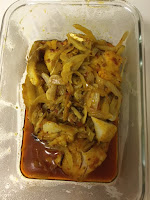
            It’s to be served with toasted almond slices and chopped stuffed green olives. I do add the almonds (often not toasted), but I’ve never liked stuffed green olives so leave them out. I should have taken a photo of my plate, but here are my leftovers. 

           (Sorry for the amateurish layout. Blogger is very poor at this.)

-------------------------------------

I’m participating in the 15th annual Slice of Life Challenge over at Two Writing Teachers. This is day 15 of the 31-day challenge.  It’s not too late to make space for daily writing in a community that is encouraging, enthusiastic, and eager to read what you have to slice about.  Join in!


Saturday, March 12, 2022

SOLSC 12: Am I a Wuss?

            I was supposed to meet a friend downtown to see a movie, in a theater! (First time in months.) Just 3 blocks to the subway from my home, and three blocks from the subway to the theater.

            At 3 p.m., I left my building to walk up from Riverside Drive to Broadway. There’s a slight hill — and a stiff wind coming off the Hudson River. I walked halfway up the block with walking sticks and felt all right — but then I thought ahead. I’d be coming home in the evening, the wind could get worse, there’s snow predicted.

            I turned around to feel the wind in my face. It was strong and steady. I remembered a day last year when I was so battered by wind crossing a broad street that I retreated to near a building until the wind weakened. I do not want to fall. I felt like a wuss. But I decided not to take the risk.

            Back in the lobby of my building, the super told me five older people in our building have fallen walking down our block. I’m almost 80. My husband fell on slushy ice and was dead two years later. Now back in the safety of my apartment, I keep telling myself, “You’re smart, you're not a wuss.” Maybe “I’m a smart wuss.”


-------------------------------------

I’m participating in the 15th annual Slice of Life Challenge over at Two Writing Teachers. This is day 12 of the 31-day challenge.  It’s not too late to make space for daily writing in a community that is encouraging, enthusiastic, and eager to read what you have to slice about.  Join in!


Friday, March 11, 2022

SOLSC 11: More Notes from the Copy Editor

My freelance work involves copy editing book reviews for a trade magazine, and the next day, cleaning up the digital files after the editors have dealt with my queries, and the queries of their boss. Most of the time, editors accept my changes or rephrase in response to questions. I feel particularly happy when an editor notes: “good catch.”

            Today I had one “good catch.” The reviewer of a science fiction story referred twice to “the Dream City”; I queried whether that was exactly how it was called in the book, or was it simply “Dream City.” Indeed, no “the” was needed, and the editor thanked me. In another science fiction review involving the revival of ancient humans, a character was called “Homo ergaster”; I queried the spelling since I’d never seen “ergaster” before. The editor deleted the weird word and replaced it with “erectus,” and Homo erectus is definitely the term for early hominids.

            I also untangled a couple of murky sentences, after which I queried: “this what’s meant?” It

seemed to be yes.

            Then there’s spell-check. A character in a romance novel was described as a “hotty.” I’d read right over that on my first pass, but when the spell-check stopped, I looked it up, and M-W says the correct spelling is “hottie.” (Who knew?) Spell-check stopped at “peppiness” but went right past “benzodiazepine” (in a memoir review); “benzodiazepine” is in Adobe’s dictionary? We're not a medical magazine.

            The managing editor thinks there are too many hyphens, so I’ve started a hyphen check. I sometimes think I spend half my time determining whether a term is one word, hyphenated, or two words: “lakefront”? one word; “bedrest”? two words; “dayslong”? needs a hyphen. Then there’s the accidental catch. Spell-check went right past “page-tuner” — “tuner” is a word, after all. But my hyphen-check stopped, and my brain noticed the missing “r” in “page-turner.”

            I love these questions and solving the word problems.  It’s not a job for everyone, but it’s certainly worked for me.

-------------------------------------

I’m participating in the 15th annual Slice of Life Challenge over at Two Writing Teachers. This is day 11 of the 31-day challenge.  It’s not too late to make space for daily writing in a community that is encouraging, enthusiastic, and eager to read what you have to slice about.  Join in!