Saturday, March 3, 2018

SOLSC: Louisiana History


            Today I spent a couple of hours at the Cabildo, part of the Louisiana State Museum. The Cabildo dates from when New Orleans was part of the Spanish empire and the building was the site of the government council. Today it has exhibits from the 1815 Battle of New Orleans—fought about a month after the war had actually ended—up through Reconstruction. Here are some bits of information I learned.
            1. Joseph Savary, a free black man and professional soldier, formed a battalion of other free black men in 1814, called the Free Men of Color of the Louisiana Militia, and was the first black man to reach the rank of major. This battalion turned the tide against the British, leading to American victory. However, the white citizens of New Orleans were too uncomfortable with any armed black men, so the battalion was ordered to leave the city.
            2. The 1959 hit song “The Battle of New Orleans” was written by an Arkansas schoolteacher, Jimmy Driftwood, in the 1930s to teach his students about the war. It became a #1 hit when Johnny Horton recorded it in 1959. Oddly enough, it also became a hit in Britain, though some of the lyrics considered insulting by the British were altered without changing the actual history (“bloomin’ British” replaced “bloody British”).
            3. One room compared myths with history, pointing out, for instance, that while Hollywood movies like The Buccaneer (1938 and 1958 versions) made the pirate Jean Lafitte the ultimate hero of the 1815 battle, he actually played a very minor role. Andrew Jackson also was lauded as the ultimate hero, but not everyone was impressed. Some local citizens thought he was taking too long to lift martial law, and Jackson put one of them in jail. When a journalist wrote about this, Jackson jailed him as well. Later, Jackson was fined $1,000, approximately $17,000 today, for his high-handedness.
            4. And Louisiana’s electoral votes never went to Andrew Jackson in his three runs for president, when he lost in 1824, and won in 1828 and 1832.
            5. The Louisiana Purchase was rather like a three-way baseball trade. Spain turned over its territory to France on November 30, 1803, and France in turn sold it to the United States a few weeks later, on December 20.
            6. New Orleans’ population continued its diversity from its settlement by Spain and France. In 1850, the city had immim grants from Ireland (20,000), Germany (11,500), France (7,500), and England and Scotland (2,500). The population also included 13,500 enslaved people and 11,000 free blacks, as well as 50,000 native-born in New Orleans or migrants from other states. 
-------------------------------------
I’m participating in the 11th annual Slice of Life Challenge over at Two Writing Teachers. This is day 3 of the 31-day challenge.  It’s not too late to make space for daily writing in a community that is encouraging, enthusiastic, and eager to read what you have to slice about.  Join in!

Friday, March 2, 2018

SOLSC: Falling, Again


            After losing then finding my phone yesterday (in yesterday’s Slice of Life story), I went to dinner at one of New Orleans’s most famous, and oldest (since 1840), restaurants, Antoine’s. The food was delicious (soft-shell crab with butter-almond sauce and a roasted corn side. Along with food a very good chardonnay. I mention the wine because it may have contributed to what happened later.
            After dinner I set out to walk back to my B&B. When I got to Bourbon Street, the crowds of people in the street and music coming from all the clubs and bars lured me to join them. I strolled along for a few blocks until the crowds thinned.
            As a car approached from behind, I thought it was time to get back on the sidewalk. Unfortunately, I picked a spot where a driveway curved into the sidewalk, and as I stepped up, my foot landed badly, and I fell forward. Not as badly as two years ago, but in protecting my head, I jammed my finger against the pavement.
            Passersby stopped to help. A self-styled street person said he’d seen many people fall where I had, then asked if that made me feel better. (It did.) After severa; minutes, I gathered myself and got over my shock. They helped me to my feet, and one couple walked me up to the main street, and I walked, gingerly, back to my local home.
            The B&B proprietor had a good first aid kit, and I went off to bed wondering how sore I’d be in the morning.
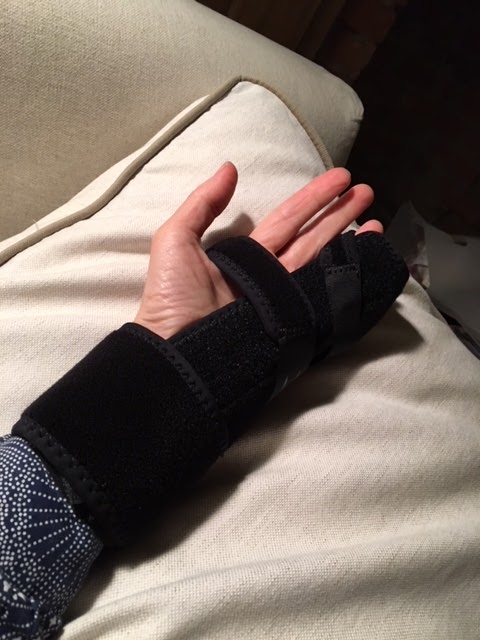
            By which time, my skinned knee felt fine, but my left pinky was very painful whenever I bent it. So off to an Urgent Care clinic to see whether there was any broken bone. Fortunately, there wasn’t. And the x-ray tech gave me this brace (left) to hold the pinky and its neighbor steady—the C component of R(est), I(ce), C(ompression), and E(levate). 

-------------------------------------
I’m participating in the 11th annual Slice of Life Challenge over at Two Writing Teachers. This is day 2 of the 31-day challenge.  It’s not too late to make space for daily writing in a community that is encouraging, enthusiastic, and eager to read what you have to slice about.  Join in!

Thursday, March 1, 2018

SOLSC: Phone Lost, but Not Lost


Just over a year ago while on a tour of Cuba with my daughter, I lost my new smartphone, which I’d had for only a few months. That was a Slice for December 20, 2016
            Today I am traveling again, this time on my own, and in New Orleans. I had finished going through a very moving exhibit about Hurricane Katrina. At the opening of the exhibit is a battered piano tilted at a 45-degree angle. The piano was Fats Domino’s and was found in his house on Marais Street. The house had been totally destroyed during flooding from the hurricane, and the piano ruined. For a while, people thought Fats had died as well, but he had evacuated to a relative’s. The piano was donated to the museum, and it’s set up in the position it was found.
            Of course, I wanted a photo. I reached into my purse for the phone. No phone. My pockets? No phone. Panic. I tried to search through my purse more thoroughly, but also asked at the reception desk if I had left my phone there. I hadn’t, but the receptionist suggested the call-my-phone feature, and after I gave her my number, she dialed it. I didn’t hear a ring from any of my belongings, so while she continued to listen to her phone ring, I rushed through the exhibit, hoping to hear my phone’s blues ringtone. Silence.
            Back at the reception desk, I suddenly heard ringing from my backpack. There was the phone. Why hadn’t it rung in the first place? My phone seems to put itself on vibrate on its own sometimes. Devices have minds of their own.
            This trip the phone was found. But in my euphoria on finding it, I forgot to take a picture of Fats’ piano. So no  photo here. I’m sorry. 
-------------------------------------
I’m participating in the 11th annual Slice of Life Challenge over at Two Writing Teachers. This is day 1 of the 31-day challenge.  It’s not too late to make space for daily writing in a community that is encouraging, enthusiastic, and eager to read what you have to slice about.  Join in! 

Tuesday, February 6, 2018

SOLTuesday: Printer Update


Last week I reported that I was breaking through my internal doldrums and had replaced the printer that no longer worked. Over the weekend I unpacked the new printer, plugged it in, and started to set it up. But it was stuck at the “connect to wi-fi” step. I have two networks, a primary one and a guest one, and none of the passwords I had written down worked. Everything failed.
                  Friday, Saturday, and Sunday I kept trying. This was made more complicated because I have two Airporters (routers), one to extend my network to all corners of my apartment. After one of my failed attempts, the primary network no longer appeared in the list of available networks, and the extender Airport has a flashing yellow light. Once the primary network disappeared, one of my laptops lost its Internet connection and had to be logged in to the guest network. My phone initially was still attached to the primary network, but then I had to log it on to the guest network.
                  Sunday night I spoke with my brother, the computer wiz, but he doesn’t even use Airports anymore. And before I went to bed, I noticed that the Airport Utility no longer found any wireless devices, even though I was still connected to the Internet through the guest network. I was beginning to feel like I had entered the Twilight Zone.
                  Yesterday afternoon I called Apple Support and spent almost an hour with a technical assistant. First he had me reset the primary Airport (this is the high-tech method of poking at an indentation with a paperclip). Finally, it showed up in the Utility, and we went through the steps of setting up the Airport, with me explaining to him what had gone wrong in the past, and him explaining things that had confused me, like, Ethernet being the connection—this referred to the Airport’s cable connection to the cable modem. Ahhhh.
                  Now it all worked, the “new” password was successfully updated. Then I asked Ronnie whether he could stay on the line with me while I set up the printer. Really, I asked, if the printer doesn’t accept this wifi connection, who should I call: Epson or Apple? Who’s responsible? He laughed at that, and said, sure, since he’d been on the phone with me this long, he could stay a bit longer.
                  So he walked me through each step, and this time, the wifi connection was successful. And then the extender Airport showed up in the Airport Utility, and later I noticed that its light had turned green, with me not having to do anything. And all the devices are now connected via the primary network, not the guest network anymore. They just did it by themselves. Thank you, thank you, thank you. 
-------------------------------------
It’s Slice of Life Tuesday over at Two Writing Teachers. Check out this encouraging and enthusiastic writing community and their slices of life every Tuesday. And add one of your own.

Tuesday, January 30, 2018

SOLTuesday: Getting Moving


Last week I was feeling bogged down by the pileup of objects in my life that were breaking—and I was doing almost nothing to take care of the problems. (See my Essay #4 here.) Yesterday, the dam broke, in a good way.
            First of all, I found the receipt for the printer that no longer prints, and discovered that I was within the period of the 2-year product replacement protection I had bought for $10. Next,
I tested the stuck bureau drawer, as I’ve been doing randomly for weeks, and it opened! Did it fix itself? So, I took the printer back to Best Buy and got a new one, and paid another $10 for replacement protection. Easier than getting it fixed because I would have been without it for as long as it took them.
            Now all I have to do is send off the shoulder purses with broken zippers to be fixed with the lifetime guarantee the company offers. I’ve had these purses for many years and have gotten them fixed many times. Just felt stuck this time. Once that gets taken care of... what new obstacle will present itself to me to be overcome?

-------------------------------------
It’s Slice of Life Tuesday over at Two Writing Teachers. Check out this encouraging and enthusiastic writing community and their slices of life every Tuesday. And add one of your own.

Saturday, January 27, 2018

Essay #4: Breaking Down


           It started last summer. Actually, maybe it was the beginning of last year. Here's the setup. Many years ago I bought a handbag made by Eagle Creek. First, it held everything I needed to carry with me, yet was still small enough that I wasn't tempted to carry more than I needed. Plus, the manufacturer said it has a lifetime repair guarantee. Should a zipper or the brackets holding the straps break, I could mail it to a designated repair place, and it would be fixed. So I bought a second, identical bag, so when I had to send the first one off for repair, I'd just start using the second, and vice versa.
            After years of happily doing this, I noticed that the times between breakdown were getting shorter. When the zipper on bag2 broke just a few months after repaired bag1 had been returned to me, I started using repaired bag1, but didn't send bag2 to the repair shop. Why not? Did I think the repair people were getting tired of fixing my bags? Did I think they weren't replacing the broken zipper with a new one, but were simply straightening out the old zipper so it would work—for a while? Whatever, bag2 sat on my desk, and still sits there.
            Meanwhile, last summer, the main zipper on bag1, which used to zip either to the right or to the left, is now only zipping in one direction. Which means, oh, I won't go into the OCD details of why this matters. The fact is, both bags need fixing now, and I can't send both of them to the repair shop unless I have another handbag to carry my essentials. And I'm not buying a new bag.
            But it's not just these two broken-zipper bags. About a month ago, I wanted to wear a long-sleeved shirt, but when I went to open that drawer of my bureau, it wouldn't move. Ah, that explained the odd loud, unexplained noise I'd heard the night before. I jiggled the drawer—no change. I removed the drawer above and the drawer below, but there was no way to access whatever had broken inside to block that drawer from opening. I should add that about a year earlier, a piece that ensures smooth opening of the top drawer had also broken, but that drawer still opens and closes. I should further add that this bureau is older than I am. Blond wood, Heywood Wakefield, circa 1940, one of the first pieces of furniture my parents bought after they got married, I think.
            My first impulse was to replace it with an identical bureau. An Internet search revealed that all such bureaus are used, and who knows what shape they are in, if I can "inspect" them only via computer screen. Further Internet research revealed that no bureaus I can inspect in a store have exactly the dimensions of my old bureau. Plus, they are really expensive. Finally, I took a long (subway plus bus) ride out to Ikea in Red Hook, Brooklyn, where I saw a couple of bureaus that might work, but I have to write out their dimensions and compare them to what I have to make sure I am making the absolute correct choice—especially since what I really want is a replica, not something different. (Is this more OCD?)
            And wait, there's more. A couple of weeks ago, my printer stopped working because the yellow cartridge was empty. The cartridges of this Epson printer do seem to run out frequently, Was it annoyance over this apparent fact that prevented me from going out that day or the next to buy more cartridges? Whatever, it took over a week for me to buy the required cartridge and another few days to replace it. Once I'd made the replacement, I clicked "Copy," the first task I needed done. The printer made its usual sounds, paper came out—but nothing was on it. Meanwhile, I'd left the printer open (so I could remove the old cartridge and take it to the stationery store to show what I needed; doesn't everybody do that?). Had that caused some harm to the printer's innards? I don't know, because I have neither taken the printer to a repair place nor called Epson for repair help; I'd have to dig out my receipt to see if the printer is still under warranty, and the longer I wait, the more likely it won't be.
            So, three major parts of my daily living are broken, and I'm making little to no progress in getting them fixed. What is wrong with me?

Sunday, January 21, 2018

Essay #3: Letters, Keeping in Touch with Comics, Part 2


Other comics we (my brother and I, at least) read included Pogo and Mad magazine. It wasn’t until years later that I learned we may have been reading Mad from its inception in 1952. When you’re a kid and you find a new comic or magazine, it doesn’t occur to you that it never existed before.
            Mad was obviously subversive, making fun of everything in sight. Was it the take-offs on TV shows that made them silly, or sillier? Was there political satire I might, or might not, have noticed? Being the child of semi-closeted lefties, I already knew not to believe everything I saw on TV; I wasn’t reading newspapers much until I was a senior in high school.
            But how did we know Pogo was subversive? Was it the reworking of Christmas carols (“Deck us all with Boston Charley,/ walla-walla-wash and kalamazoo/Nora’s freezing on the trolley/Swaller dollar cauliflower, alley-garoo”)? Was it the recurring character protesting, “Destroy a son’s faith in his father?”
            Once I left home, I probably kept up with the comics in the Washington Post the two years I lived in that city. And we read the few comics that were in the New York Post once Jack started working there, and continued to get the Sunday Daily News for our full fix until the 1990 strike at that paper, when we got out of the habit and never went back.
            As an editor at the now defunct publisher Bobbs-Merrill, I was happy to include comics in Pepper Schwartz and Janet Lever’s 1971 book about the early years of women being accepted as students at Yale, Women at Yale: Liberating a College Campus. They suggested we use comics from then-student Garry Trudeau. Working at the Village Voice, I got to copy edit the comics of Jules Feiffer, Stan Mack, Mark Stamaty, Matt Groening, Lynda Barry—just to make sure their words were spelled correctly, nothing more.
            But I wasn’t a big fan of comix or zines. The misogyny of the drawings of women had become repugnant rather than an element to be overlooked. But didn’t Dykes to Watch Out For run in Ms. magazine? I know I read that comic. And there were lots of feminist political illustrations that I think of as “comics,” like the famous on of two women walking down a staircase in the background, while one of their dates waits nervously; the overline: “Careful, honey, he’s anti-choice.”
            Of course, I read the graphic “novels” Maus, in 1986; Harvey Pekar’s Our Cancer Year, in 1995; and Persepolis, in 2003. Why of course—because these comics had literary claims? Many of these new graphic “novels” were personal, which seems especially suitable to the combination of illustration and text. Maus’s subject, the Holocaust, lent its gravity to the format. The image of young Iranian girls turning their hijabs into horse reins or robber masks in Persepolis demonstrated a perhaps unconscious subversion. Graphic novels are now an established form of literature, comics grownup.

Thursday, January 11, 2018

Essay #2: Letters 2, Keeping in Touch with Comics, 1

In my second week at Antioch College, October 4, 1960, I wrote to my brother, showing off my dissipated life. After the Josh White concert (see last week’s essay),
“some boys from Siwannee, one of the better boys dorms asked us to a party. It was really dead. One fellow was drinking beer out of a mug, and every time he opened a new can it dripped all over the floor. The other one kept talking about the importance of comic strips and how you shouldn’t let yourself get out of touch with that is going on in the world of funnies.”
            This is one of those scenes I have no recollection of. I don’t remember the name of that boy, so no way to learn whether he ended up in the comics field, either as writer, artist, or critic. From my dismissive tone—the party was “really dead”—I must have thought “the funnies” were childish fare not worth the attention of a college student.
            But I liked “the funnies.” Our Philadelphia newspaper had, I think, two pages of comic strips ranging from Dennis the Menace to Prince Valiant. And my interest in reading comics goes way back to early childhood.
            I still have a battered (and much marked up) copy of Crockett Johnson’s Barnaby (Blue Ribbon Books, 1943), a collection of the cartoon that ran in the left-wing New York newspaper PM. During World War II, a small boy named Barnaby wishes for a beautiful fairy godmother, and instead, one night, a cigar-smoking, fat little fairy godfather with pink wings flies in his window. Naturally, his parents try to convince him that Mr. O’Malley is only a dream, but stranger and stranger things begin to occur. For instance, an old abandoned house in the neighborhood is believed to be haunted. Mr. O’Malley’s attempts to rid the house of “fiends” accidentally uncovers a gang hijacking trucks carrying bags of coffee and hiding them in the haunted house—and the parents and police all believe Barnaby and his friend Jane are the heroes for uncovering the thieves. I read this book multiple times, colored in some of the drawings, wrote comments in the margins.
            The barbershop on our block of 20th Avenue in Bensonhurst discarded out-of-date comic books in a box outside the shop, and neighborhood kids would sit on the sidewalk reading them. There were Classic Comics (classic stories like Treasure Island and The Count of Monte Christo told in comic book format), Blackhawk (a World War II comic with a crew of pilots from central casting, as well as stereotypical Japanese enemies), and Superman. Our mother didn’t care if we read comic books; any kind of reading was reading, and was good.
            The newspaper comics I remember most were the “soap operas”: Mary Worth, Brenda Starr, Mark Trail. I also read Terry and the Pirates, Steve Canyon, Dondi, as well as Peanuts, Archie, Lulu, Nancy, and Pogo. There are surely others, but I don’t remember whether any of the superheroes were syndicated in the newspapers in West Haven and Philadelphia suburbs where I lived through the 1950s.
(to be continued)

Friday, January 5, 2018

Essay #1: Letters, 1

It’s a cliché by now that nobody writes letters anymore. They started saying it when e-mail took over, and e-mail became email when txts took over. No one saves either e-mail or texts, unless they are old obsessives like me. But back when people did write letters, other people saved them, on whatever pieces of paper, or stationery, or notepads they were written on.
            When I went off to college in 1960, I wrote letters home, to my parents, and occasionally to my brother and/or sister. My mother saved them. Sometime in the past, [possibly when they sold their house in Pennsylvania and moved south, eventually landing in Florida,] she sent them back to me. [I’m guessing about the timing because one folder is all my letters from the 1960s, and they moved south in 1970, but maybe I’m wrong about this. Need to check what other letters of mine are filed away]
            I only recently began to reread them, and that is a fascinating exercise. First of all, I can see the seeds of my eventual career as a copy editor in my first letter questioning the spelling of the word “dillys” (I was describing the evaluation tests all the freshmen took to see what courses we would have to take for general education credits, which I said were “real dillys”; without looking it up in a dictionary, I’m guessing it perhaps could be “dillies,” though that looks wrong, too). On the other hand, I misspelled other words without wondering about them: “dissapated,” “deroggatory.”
            Second, all that ancient slang! “Kooky characters,” “they are all nuts,” “skuzzy bunch of boys.” And not so ancient I definitely used “hysterical” to mean “hilarious”—is that when that started, or have people been using hysterical instead of hilarious long before 1960?
            Then there are the scenes I don’t remember. In my letter to my brother, I mention meeting another freshman from the next town over from ours outside of Philadelphia. He knew many of my brother’s friends and said he was their business manager; I think they were in a band. And I express astonishment that one of those boys is a Merit Scholarship semi-finalist.
            And the scenes I do remember, once I read what I wrote about them. One night at dinner that first week an upperclassman sat at our table and introduced himself as a foreign student, though it was obvious he wasn’t. This is what I described: “Then he started talking Russian to me. He had a glass of water, and suddenly he put it to his lips and tipped his head back, as though he were drinking. But the glass was empty. He said he was looking at the lights, that’s the way they did things in his country. Then he asked us what country we came from.” My roommate and I thought this was one of the funniest things we’d ever seen, and I do vaguely remember it.
            Then there are the scenes I remember, but which I remembered in widely different circumstances. The Josh White concert, for instance. In my memory, this was probably my second year, or even third year, and I was on a date. I remembered this because during one of his encores, a string broke, and White continued singing as he restrung the guitar, without missing a beat. But the evidence from my letters says this happened my first week at school, and I know I did not have a date that early in my college career. This is one of many experiences that have taught me the fallability of memory.
-->
            I plan to continue writing about my discoveries in my letters that I hope will be interesting to strangers. 
-->
--------------------------------------------------------------
This year there is another essay a week challenge, 52EssaysNextWave. If you’d like to try it, go to the Facebook page for 52EssaysNextWave and sign up. Or just read some of the essays that will be linked to there.


Tuesday, December 26, 2017

SOLTuesday: Letters from the Past


My mother kept the letters I wrote her all through the 1960s—from college, living on my own, and my early married days—and some years ago she sent them back to me. I only started to reread them in the past few days.
            When I told my daughter, she related that her husband, Richard, had a box of letters that his uncle had sent to Richard’s mother during World War II. So for Christmas Day, I proposed that we bring out our caches and read them aloud to each other.
            It was a fascinating exercise. Richard’s uncle died during the war, so one of the letters was one his mother had written and was returned to her. It was her plea that her brother intercede with their father about a boyfriend she had that apparently the father didn’t approve of. In an earlier letter her brother had teased her about her boyfriends, who seemed to change with every letter.
            My letters included some stories I remembered, but others I had no recollection of. There were letters I wrote to my younger brother detailing our “wild and crazy” life, staying up until 2 a.m., going to parties at 1 a.m., descriptions of “boys” trying to impress us by acting silly. And then there was the slang that hasn’t survived and the slang that has: “kooky,” “nuts,” “skuzzy,” “hysterical.” Here’s what I told my brother about my college: “To be a non-conformist here you have to wear a suit, and a tie, be clean-shaven and neat. The normal costume for upperclassmen is dungarees, dirty sweatshirt, and sandals.”
            Each letter prompted memories or stories or speculation. It was fun, and to be continued, since we barely made a dent in my letters, and there are still some of Richard’s relatives we haven’t seen yet.
  -------------------------------------
It’s Slice of Life Tuesday over at Two Writing Teachers. Check out this encouraging and enthusiastic writing community and their slices of life every Tuesday. And add one of your own.

Tuesday, December 12, 2017

SOL Tuesday: Grief, Revisited


I met with my financial planner today at TIAA. She was looking through her folder for me and noticed that all the statements there were from 2012. I said that was probably from when Jack and I had our meeting with her after our former financial planner at TIAA was promoted.
            I then had a memory flash of Jack sitting in the other chair in our planner’s office, a memory that felt so solid I could almost see him. The presence of the memory against the absence of his physical self felt so jarring. Is this what grief is? The presence of absence, and the absence of presence.
            There’s nothing comforting about this, but I don’t want to lose my connection to the loss that creates the lack of comfort. Is this morbid? Is it healthy for me? What does “healthy grieving” mean? Why even think in those terms?
            I so want to talk to Jack about this. We had so many family members die in the past 10-15 years: his older brother and sister, and his uncle Bill; my mother, father, and sister. We talked about it, but I doubt I wrote anything based on our discussions. Our words went into the ether, and Jack has joined them.

Tuesday, December 5, 2017

SOL Tuesday: Labyrinth Therapy


I’ve been feeling blue the past week. Two years ago this week Jack went into the hospital for what turned out to be the last time.
            Yesterday I went down to Battery Park. Jack loved New York City, as only a convert to the city can. We sometimes went to Battery Park and wandered along the waterfront. I wasn’t exactly retracing our steps, because the park has changed. There’s theSeaglass Carousel, sea-creature shaped sculptures one can sit in; it wasn’t running when I walked by, but it looked like something Jack might have liked.
            I sat facing the harbor, the Statue of Liberty across the water, Governor’s Island to the left and Staten Island beyond; Ellis Island, Liberty Island, and New Jersey to the right; and in the far distance the cranes that lift containers off the freighters and put them on trains. Seagulls perched on pilings, backs to the wind.
            Nearby, I found the labyrinth I had walked last summer. Walking it yesterday, it felt like a way of moving forward while staying in the same place. Is that where my grief is taking me these days? I do keep moving, but I seem to be still in the same place. Maybe that’s where I need to be right now. 
-------------------------------------
It’s Slice of Life Tuesday over at Two Writing Teachers. Check out this encouraging and enthusiastic writing community and their slices of life every Tuesday. And add one of your own.

Tuesday, November 28, 2017

SOL Tuesday: Is Physical Therapy Sex?


I have been seeing a physical therapist off and on for the past four years for a spinal stenosis that causes me pain in one of my legs. My therapist is a young man, well, maybe around 40, with lovely blue eyes.
            Mostly, I think he is very good. He explains what each exercise or stretch is for and in detail what each part of my body that’s involved should be doing, or not doing. Occasionally, he will do massage-like “manipulation” on a muscle or set of muscles.
            Every now and then, his work on my muscles takes a form that feels almost sexual. For instance, to work out my glutes, he had me on my back with my legs bent to my chest and my feet against his chest. He then used his own body as a weight to put pressure on my legs. It did indeed stretch the glutes. But it also felt like a position of sex.
            Don’t get me wrong. The door to the room we’re in is open, there’s zero chance that there this is anything actually sexually abusive going on. Of course, we are both fully clothed. In fact, ever since Jack died, I have missed enormously the feeling of another person’s body against mine. (I sometimes wonder whether I continue to go to physical therapy just for the touch of another person. A friend whose husband died suddenly some years ago confessed that she’d starting getting manicures and pedicures just for the touch of another person.)
            Yesterday, we did another one of those stretches, in which he used his body as a weight to stretch out my calf muscle. I usually close my eyes during these stretches because it’s easier to feel how my body is responding if I have no visual distraction. I wonder what he thinks as he uses his body to work on the body of an elderly person. Most of his other clients I’ve seen are elderly people like me. But I can’t ask him. I don’t want him to think I think there’s anything risque about what we’re doing. But in a corner of my mind, or is it my body, I think, physical therapy is sex.
-->
-------------------------------------
It’s Slice of Life Tuesday over at Two Writing Teachers. Check out this encouraging and enthusiastic writing community and their slices of life every Tuesday. And add one of your own.