Sunday, February 20, 2022

Job #3: Saks-34th St. (first Antioch co-op job)

 This is part of a series of memoirs about all the jobs I have ever had. By "job" I mean any work I was paid for not by my parents. There will be 20 or 21 of these whenever I finish.       

How the Antioch College work-study system worked

This was one of the appealing features for me. Its cooperative education work-study program was not anything like “work-study” in colleges and universities today. In Antioch’s program, everyone spent time on campus taking traditional classes, and an equal amount of time off campus at any of hundreds of regular jobs around the country. The student body was essentially two student bodies, or divs (for divisions): one half on campus while the other half was off working. (Just to complicate matters in telling this story, my class was the last for many years in which everyone in our class started in the fall. In 1961 began two entering classes, one in the summer, the other in the fall, which lasted for perhaps 15 years.)

My class was divided into three divs: one group of students went off on a job after the fall quarter (Antioch wasn’t on a semester schedule), another group after the winter quarter, and the third group after the spring quarter. I was in the second div, so somewhere around the middle of winter quarter we visited the co-op office to look through the jobs lists for jobs (1) we were interested in doing, (2) we were qualified for, and sometimes most important (3) located in a place we wanted to go. And I, my roommate, and our closest friend (we dubbed ourselves the Traumatic Triumvirate) most definitely wanted to be doing anything at all in New York City.

I no longer remember what other entry-level jobs were available, but all three of us ended up as department store sales clerks: my roommate, known as Charlie, went to Lord & Taylor’s (at $45/wk.), our friend, Connie, at B. Altman (at $55/wk.), and I to Saks-34th ($50/wk.). There’s interesting retail history around these three stores, but I’ll save that for later.

The job


Our jobs started in early April; this is when I filled out my first W4 forms. Then three days of training. There were five or six other women being trained with me, but they all hoped to be staying on. We had to learn how to operate really old cash registers, with rows of raised “pedals” for the numbers and a handle on the side to record each price as you entered it. Then there was complexity of counting out at the end of the day. You had to get the register to total the daily transactions and then count up the cash in your envelope—and those numbers better match. Mine always did.

What else did we learn? When and for how long we could take a break and go for lunch; to be friendly and gracious to customers. What our employee discount was and how to use it. Did we have to punch a time clock? I don’t remember. And there was no mention of a union.

Once trained, I was assigned to the costume jewelry counter on the first floor, near the entrance from 34th Street. I shared the counter with a couple of other women who were much older, so we didn’t commune much. Did I say I was terminally shy? The hardest part for me was standing behind the counter, facing out toward potential customers, and trying to look helpful. If I saw someone pausing to gaze into the cases, I would edge gradually in her direction while hoping she would move along or leave before I got close enough to have to say, “Can I help you?” On the other hand, if someone knew exactly what she wanted, I enjoyed picking out the bracelet or necklace or pair of earrings, packing them neatly into a box labeled “Saks-34th,” and ringing up the sale. Mostly, I walked up and down behind the counter, rearranging items on display either on the counter or inside the cases. Time passed very slowly.

Near the costume jewelry counter was a free-standing triangular table with a few dozen watches individually chained on display. Every now and then I was assigned to “handle” that table, which meant I had to stand out on the floor near the table and look alert, ready to address anyone who stopped and picked up a watch, though they usually hurried off if I did approach. Here time passed even more slowly, though it became a sort of game to straighten out the watches to make parallel and aiming toward one point of the triangular table or another.

At least a couple of times a week, someone would stop by the counter and ask where housewares was. The first few times this happened, I was confused—we didn’t have any housewares. “But there was an ad in the paper,” the woman would say, showing me the page that clearly said Macy’s or Gimbel’s. Saks-34th was on the south side of 34th Street, while Macy’s was across 34th, and Gimbel’s was on the other side of Saks, on 33rd. Eventually, I realized that people came up from the subway and didn’t know where they were, and I felt superior pointing out where they needed to go.

Lunch was either at the Nedick’s tucked into the corner of Macy’s or the Woolworth’s lunch counter next door. Can’t remember what I ordered at the counter, but sometimes I would buy a box of melba toast and a can of smoked oysters—eating raw oysters would come later—take them back to the break room at Saks, and eat oysters on toast for lunch, feeling extremely sophisticated and elegant.

I knew about the sit-ins and picketing of Woolworth’s the year before, but those seemed over by spring 1961. The political issue I was aware of April of 1961 was the Bay of Pigs invasion of Cuba, an abortive anti-Castro attack that Kennedy inherited from Eisenhower. That and the possibility of nuclear war. (Current research tells me that the nuclear test moratorium wasn’t breached until fall 1961, but my fear of imminent war that led to personal events that summer must have been based on something. Were there stories hinting that various countries might violate that moratorium?)

One day while having lunch at Nedick’s, I heard the squeal of brakes and gasps from those around me. A gray-haired man lay in the middle of the street, hit by a car that sped off. From inside of Nedick’s I could see only a trickle of blood by the man’s head; in my memory his body is larger than the people gathering around. I looked away, but not quickly enough.

Outside the job

The job was the least reason I wanted to be in New York. Once we had our jobs lined up, we next had to find a place to live. Here, too, Antioch’s co-op office had lists of apartments where Antioch students had lived in the past. Somehow, we settled on a one-bedroom apartment on West 87th Street, between Central Park West and Columbus Avenue, which when we arrived in early April 1961 turned out to be tiny. The bedroom barely had room for a double bed, a single bed, and two small bureaus. It was weird sleeping with another woman in the same bed, but we did it for three months.

This apartment was the first place I saw a cockroach—yuck! Did we actually cook any meals there besides breakfast? I remember none.

I do remember boys, however. Charlie invited over two boys (we still called young men around our age “boys,” while we called ourselves “girls”) who worked in the stock room at Lord & Taylor, and they brought along a slightly older guy named Rudy. We sat around our apartment drinking, playing music, laughing. We must have gotten really loud because someone called the police. And when the police came to our door, we were terrified, and then astounded when they knew Rudy! The police were pretty cool, just told us to keep it down.

One night Rudy took Charlie and me for a ride in his red Corvette, with the top down. I was in the front seat as we went down to the Village, and driving around Washington Square, Rudy started chatting up a young woman with a suitcase, walking along Waverly Place. Somehow he finagled her into the car, even though there was no place for her to sit. Her suitcase went into the back, and Charlie, who’d been squeezed into a space with no seat got out and took the subway uptown. The new woman climbed over me and sat on the gearshift, hopping up whenever Rudy needed to change gears. She had a bottle of liquor in her hand, and possibly she was drunk. She kept shouting, "I'm Nell McCafferty!" Was she famous? Should I know who she was? I felt pushed into the shadows, excited yet confused. Was she going to invite us into some situation I wouldn’t know how to handle? I thought of the previous summer, when walking around the Village with a high school girlfriend, she got us picked up by a much older man. (Another story, another day.) It hadn’t ended badly, but what now? After driving around the park a few times, we let her off, somewhere.

I discovered the Scribner Bookstore on Fifth Avenue and bought perhaps my first hardcover book: Katherine, by Anya Seton. I had read this historical novel, about real-life people in 14th century England (the female romantic lead was Geoffrey Chaucer’s sister-in-law), when I was 14, and it was one of the books that attracted me to history. I bought a pale yellow hat one day because that’s what I’d read grownup women do when they feel down in the dumps. I also bought a pair of white gloves, because grownup women wore gloves in the summer as well as the winter. But nothing sticks in my memory about going to a museum or any other cultural space. The museums were known to me since my mother had taken us to MoMA and the Museum of Natural History when we visited her parents in Brooklyn. 

Aftermath

At the end of June, our jobs were over; Connie and I went home for a week, then returned to Antioch College. Charlie, however, had her financial aid cut so much that she couldn’t return. The last I heard of her, she was living with a graduate student in NYU housing in the Village. This guy drank too much, Charlie said, and she would pour his liquor down the drain. But he always got more. Where did she work? Did she stay at Lord & Taylor? I don’t know. She went out west at some point, and was friends with Connie’s sister, but then she disappeared. I admired her when we were at school, as I admired many girls in those days, but she deserves her own story. 

To get co-op credit for our jobs, we had to write a paper. The paper could be on anything: how the job compared to or contrasted with our coursework; something that happened during the co-op; what we learned about life; maybe even something creative, like a piece of fiction or poetry, or a song or music. I must have written a paper about being a sales clerk, but I did not keep a copy, and I doubt that Antioch College kept co-op papers from 60 years ago. Too bad — I'd have liked to look back on what I wrote at age 19 about a thoroughly boring job. And my taxable income for 1961 was $677 (equivalent to $6,546 today).

Now about those department stores

Lord & Taylor’s was the oldest, the first American department store, founded in 1826 and closing its physical stores in 2021. B. Altman was founded in 1865, and its flagship store, at the corner of Fifth Avenue and 34th Street, closed in 1989. It’s now the site of the CUNY Graduate School. 

West 34th Street was the first New York City location, in 1906, for the Saks & Co. store that been founded in Washington, D.C., in 1867. In 1923 Saks merged with Gimbel’s (owned by a cousin), and the following year the owners of the company opened Saks Fifth Avenue—but kept the store on 34th Street as Saks-34th. Although Saks-34th and Gimbel’s were owned by one company, they operated as separate businesses. So maybe those people who thought they were in Gimbel’s weren’t as confused as I thought they were. However, Saks-34th closed just a few years after I worked there (its closing the result, according to a 1995 story in the New York Times, “of poor layouts, no escalators, a confused identity”), replaced first by Korvette’s, then a vertical mall in the 1980s, and it’s now an outpost of the Swedish H&M stores.


Wednesday, February 9, 2022

Job #2, Robin Hood Dell usher

This is part of a series of memoirs about all the jobs I have ever had. By "job" I mean any work I was paid for not by my parents. There will be 20 or 21 of these whenever I finish.       

              Robin Hood Dell was an outdoor concert space in Philadelphia’s Fairmount Park. Concerts were free for people who didn’t mind sitting on blankets on the grass. But there were a few thousand permanent folding seats close to the raised stage where the orchestra sat, and these seats were for those who paid for a season. There were also jobs for young people to be ushers (all girls) to take the season ticket holders to their seats, and also to be valets (all boys) to park the cars of the season ticket holders. There were concerts several times a week for a six-week summer season, and ushers who worked three nights a week were paid $5 a week.

            Ushers arrived at the park about an hour before concert time. Most likely no one would need our services so early, but just in case... We brought a piece of cloth to wipe off the seats, which were clean anyway, but just in case... Then three or four of us stood around chatting, about what else we were doing that summer, who was dating whom, where we were going to college in the fall. I became friends with Lois, a friendly, red-haired, slightly plump girl who was starting at Penn (University of Pennsylvania, in Philadelphia, not to be confused with Penn State, out in State College). Lois was dating Barney, one of the valets.

            As couples, or groups, many middle-aged or elderly, arrived, we would approach them with a helpful expression on our faces. This was the hardest part for me. I was intensely shy, didn’t know how to talk to anyone, let alone strangers. But here there was the framework of the job. I would hover near the area where people walked in and try to look friendly. A little smile? The man, and it was usually a man, would hand me the tickets. I would look at the seat numbers, then lead the couple or group to their seats. There, I would fold down the seat, wipe it with my cloth, step back to they could get to their seats, and hand the tickets back. The man would then hand me a coin, for a tip. It was usually a quarter. (The equivalent today of $2.35.) By the end of an evening, I might have accumulated $2 or $3, and could have gotten more if I were more assertive in approaching ticket holders.

            One elderly couple was notable. They were older than most. And after I’d wiped their seats and let them move into their row, the man would hand me a dime with a little smile. I couldn’t tell whether he thought this was a magnanimous amount or the least that I deserved. But a dime? (Less than a dollar today.) Even then, it seemed stingy. I wanted to throw it back at him, but I never did. But I never forgot.

Tuesday, February 1, 2022

Job #1: Babysitting

   This is the first in a series of memoirs about all the jobs I have ever had. By "job" I mean any work I was paid for not by my parents. There will be 20 or 21 of these whenever I finish.       

          Is babysitting a job? Not if it’s only now and then. Not if I hated it. I was only comfortable if the baby/child/children were asleep when I arrived, which they usually were. There was the occasional child I had to put to bed, but  nothing memorable to make permanent imprint on my memory. The number of times I baby-sat may not have reached double digits.

            All of my babysitting happened in Levittown, Pa., where my family lived for three years, when I was in high school. Levittown was divided into sections with cutesy names: the section I lived in was Snowball Gate, and all the streets in Snowball Gate began with the letter “S.” My street was Sweetgum. Maybe there was a sweet gum tree planted somewhere in Snowball Gate.

            How did I get these jobs I didn’t want? Maybe my mother saw a sign in a neighborhood store. I would call, find out the date and the time range — it couldn’t be too late even if it was on a weekend. I would either walk to the home where the children lived or be picked up by the father and driven to the home if it was beyond walking distance or it was dark out. I often didn’t know either of the parents, and it felt weird to be in a strange house, even if the layout was similar to my own home. Snowball Gate had four different home layouts, and they alternated down the street: layout A, B, C, D, A, B, C, D, you get the idea.

            If the baby or children were asleep when I arrived, I was vastly relieved. This meant I could sit in the living room and watch television or read the book I had brought or do my homework. I could have explored these strange houses, looked through their books, eaten food in the kitchen, but I did none of these things. I was afraid, but not quite sure of what. Maybe I would disturb something, and the parents would be angry. Maybe I would eat food they were planning to eat the next day. Maybe I would find something I didn’t want to know. I had already poked around my own parents’ bedroom and found a book about sex from the Soviet Union; it described a young man who had rigged up some sort of alarm system that would wake him during the night so he would never miss an opportunity to masturbate. I wasn’t quite sure what this meant, but it gave me an unpleasant feeling.

            Mostly I just wanted to walk in the door, sit in a chair, hope the children would remain asleep until their parents came home and the father would drive me home after putting some wrinkled bills in my hand. I didn’t talk in the car, and the father usually didn’t ask any questions. Oh, when the parents walked in the door, the mother would ask how everything went, did the children stay asleep.

            I hated it if the phone rang. I would have to answer, because the ringing phone might wake the children. But I didn’t know phone etiquette. “Hello,” I would say. When they asked for Marge or Harry, I’d mumble, “They’re not here. I’m the babysitter.” If I was lucky, they’d say, “Oh, I’ll call back tomorrow.” If I wasn’t, the person would want to leave a message; I would have to find a piece of paper and a pen or pencil, and then worry that I wasn’t understanding what the person was saying. I didn’t know that I could just ask them to repeat. And then I’d have to remember to tell the parents, when they got home, that there had been a phone call.

            I didn’t worry too much about someone breaking into the house. Crime wasn’t an issue that I was aware of in Levittown. A few years earlier, when we had lived in the Connecticut countryside, there was a spate of UFO sightings. One evening I was babysitting my own brother and sister, and on the phone with a girlfriend. She told me there had been some strange lights in the sky over the area where I lived.  I was in the living room in front of a big picture window and slowly turned around to look out into the dark night. No lights in sight. But I remained staring out the window, unable to turn away from where the aliens might be coming from. In Levittown, I could tune out any unknown house creaks and cracks by turning on the TV. But the presence of a house on either side of the one I was in was reassuring.

            That is all the paid work I did in high school, other than the chores I had to create to justify asking for an allowance from my parents. My father didn’t understand why my brother and sister and I might want an allowance. If we wanted anything, all we had to do was ask — and maybe we’d get it, if the parents thought it was a good idea. That we might independently want to decide to get something — a book, a soda, a candy bar, a sweater — didn’t fit into their idea of child-rearing. So when I was 17, I created a list of chores (such as setting the table, clearing the table, doing the dishes), a schedule of who would do what when, and presented the list to my father with the suggestion of $5 a week. To my surprise, he accepted it. The list was posted on the side of the refrigerator.


Saturday, January 29, 2022

Remembering Connie (1943–2022)

Connie died on January 1, at the beginning of the month in which she was born. She stopped short of her 79th birthday.


Antioch College, Yellow Springs, Ohio

            I met Connie in September 1960, our first week of college in “the southwestern subculture” of Ohio — so said our college acceptance packet. We were in the same hall, and somehow we gravitated toward each other. She was petite, with dark curly hair, and expressions that flashed between sober and gleeful. She had a way of walking that looked almost like dancing, and she sometimes went to Friday night folk dancing on Red Square (this was a place on campus paved with red brick).

            She was from Long Island, as was my roommate, Eileen, who wanted everyone to call her Charlie. We called ourselves the Traumatic Triumvirate. We thought being neurotic was the thing to do and could have been models for Jules Feiffer’s neurotic young women in the Village Voice, which we hadn’t yet seen.

            Connie had spent several years with her family in France, which was very exciting to me. Her father’s job? I think he was a journalist. She played the flute and introduced me to the music of a jazz flutist named Buddy something — I want to ask her, but she can’t answer me. Many years later, when she lived in New England, she happened to meet Susan Palma, a flutist with the Orpheus Chamber Orchestra (a group that my husband, Jack, and I have had a longstanding subscription to), and played with her; was it a performance? a workshop? just hanging out together?

            Our first or second week, we walked into the village where our small liberal arts school was located. On the way to Xenia Avenue, aka Route 68, the main drag, we passed a gift shop. “Let’s go in,” Connie said. Inside, we wandered from display to display, admiring necklaces, earrings, rings. One ring in particular appealed to me. It had a mottled green stone, set in a silver band, surrounded by flattened silver balls, and etching covering the band. It was beautiful, but it was expensive: $5. (That would be almost $50 today.) I passed it up. When we left the shop, I noticed that Connie had bought the ring. I knew she wasn’t rich and thought, if she can afford that, so can I. I went back to the store, but the identical ring wasn’t in the case. There was one with the same stone, but no etching on the band. It wasn’t quite so beautiful, but I wanted it anyway. More than 60 years later, I still have it.

            After folk dancing, people sat on the Student Union steps and sang folk songs. Did she date any of the folksingers? One of the songs on the steps was “Freight Train,” lyrics by Elizabeth Cotton. Her grandson Gabe sang it at her memorial. She also came to the rock and roll dances in the North Hall Common Room on Saturday nights.

            Connie taught me how to smoke. I was terribly shy, had never learned how to just talk to people, especially someone I might be attracted to (read, boys). I noticed at the library that people went to the lobby to smoke, and if you had a cigarette, it was normal to ask for a light. Asking for a light might lead to more things to say, or do. If I learned to smoke, maybe I’d learn to talk to strangers.

            Connie smoked Kents. I asked her for a cigarette in the ladies’ room; I didn’t know this was called “bumming.” I lighted a match, held it to the tobacco end, breathed in—but then what? I coughed. Everyone coughs on their first cigarette. “Here,” Connie said, “inhale the smoke into your lungs. Watch me.” That seemed impossible, but I watched her and tried it myself, and soon I looked like a grownup in a movie, holding the cigarette between the first and middle fingers of my left hand.


New York City, I

            Connie, Charlie, and I all wanted to be in New York City for our first Antioch co-op jobs in the spring of 1961. (Antioch College had what was called a co-operative work-study program. Students spent three months on campus taking academic classes, then three months on a real job, usually paid, anywhere in the United States. To get co-op credit for the job, students wrote a paper, about the job, about how the job linked in to academic work, or even something creative. Students did not pay tuition for the time that we were not on campus.)

            We didn’t care what we were doing, so long as we were in New York City. So we all got jobs at now defunct department stores, me at Saks-34th Street ($50 a week), Charlie at Lord & Taylor ($45), Connie at B. Altman’s ($55). We rented a tiny one-bedroom apartment on West 87th Street, between Central Park West and Columbus Avenue, from a list of apartments regularly rented by Antioch students in New York City. (This apartment was my first sighting of a cockroach.) We had another Antioch student roommate because she needed an address; her Antioch College boyfriend had his own apartment on West 72nd Street, rent paid by his father, and that’s where she spent all her time.


Antioch College II

           Back to school for the summer quarter (Antioch was now open year-round), we lost Charlie because her financial aid was cut. Connie and I roomed together in a small dorm that used to be a private house. She had a boyfriend named Larry in a boys’ dorm called Orton. So, for Antioch’s regular joke photo, the girls in our dorm dressed up in bathing suits and called ourselves the “Orton Piece Corps.” (Larry’s parents were both psychologists, and he became proof to us that being a psychologist was no guarantee that your children would be without emotional problems.)

            In the fall Connie went to Detroit for her co-op job, at a mail-order bookstore selling spiritual and esoteric books. I think she came back for the winter quarter and then returned to Detroit for her spring co-op job — while there I think is when her father died, and she couldn’t come back to Antioch. We both dropped out of Antioch at the end of the spring quarter of 1962, Connie staying in Detroit and, I think, taking some classes at Wayne State University, and I was in Washington, D.C., which is where my co-op jobs had landed me.

            It was winter 1962 that we had strange weather. One day in January it was 14 degrees below zero; your breath crackled as you exhaled, moisture in your breath freezing instantly. In March it was balmy, in the 60s. Connie asserted that when the seasons speeded up like this, the world was coming to an end—and her claim has stuck with me. (We hadn’t yet heard of climate change or global warming.)

            Connie’s sister, Chris, was living in California and was for a while in touch with Charlie, aka Eileen, from our freshmen “traumatic triumvirate” days. But neither of us ever saw Charlie again.


New York City II

            By the summer of 1963, Connie was back in New York, in an apartment on Madison Avenue and 69th Street. In July I came up from Washington to visit her; I don’t remember what we did together, but I know I sat out by the fountain in front of the Plaza Hotel to experience the solar eclipse and was disappointed. It didn’t get dark enough to be scary, as I’d read people felt in earlier times. In the fall of 1963, the weekend after JFK was assassinated, I came to New York for a weekend work assignment and stayed at Connie’s, though she was not there that weekend; maybe she had gone home for the weekend? Either later that year or early the next year, Connie came to Washington to visit me in the communual house I was living in then. I set her up with a man named Jim Pivonka, who lived in our building but was not part of our commune. Jim was a really sweet guy, but according to Connie, he had some strange sexual inclinations. They spent another weekend together, but that relationship did not continue.

            In 1964 Connie moved to the Lower East Side, at 59 East 7th Street, between First and Second Avenue, but not for long. Just a year ago she found a picture of that apartment in the British Guardian, in a photo feature of New Yorkers showing off their wonderful apartments. This apartment still had the bathtub in the kitchen and, Connie wrote in her e-mail to me about it, “The apartment looks just the same, only a little more cluttered and ‘decorated,’ but just as shabby now as then.” I’ll bet the rent is way higher now than in 1964. If you want to see that tub in the kitchen, go here. It’s the third photo down.

           By 1965, I had moved to New York City and married Jack, and Connie and I saw each other more. We had lunch, she came for dinner (the photo on the right was probably one of these times), or we had dinner at her place. In October she had a party—was this when she moved in with Paula Sherman, one of my colleagues at Bantam Books, on Eighth Avenue near 53rd Street? In early December I made sukiyaki in my electric skillet (the big kitchen technology of the time) and Connie came to dinner, and on Christmas Eve we ate at Connie’s. We also often went to a bar on the corner of 54th Street that had Christmas lights and decorations year-round.

            In November 1965, I had plans to visit Connie after work because she had a TV, and Jack and I didn’t; CBS was scheduled to broadcast a National Citizenship Test, and I wanted to see it. When the lights went out all over the Northeast shortly after 5 p.m. that evening, it wasn’t such a long walk from where I worked to her apartment. Clearly, we never saw the National Citizenship Test that night.

            Connie was working at Matthew Bender, the legal publisher, by then, but not yet dating Don. Her boyfriend at that time was Dave Sachs, and he and Connie helped us move from one apartment on West 82nd Street to another a block away at the end of 1965. They’d met when they both worked at the Paragon Book Gallery, which specialized in Eastern books. I found this memory from her in a 2013 e-mail: “Paragon Book Gallery on Lexington and 59th St. I don't think Dave worked there for very long — I myself was only there for about a year. Seems unlikely that that building is there anymore; it was an old wood-floored, 3-story building, with a very ancient, very slow elevator, complete with elevator operator. From its window I watched the Beatles drive down 59th St. followed by screaming masses. It was above a chicken roasting shop, so the odor of roasting chicken wafted up all day long. I remember sitting with you guys in your apartment (which one doesn't matter) drinking beer, listening to Bob Dylan and telling stories.” Dave also sold marijuana. One night the four of us went out to dinner with Gerald, a good friend of mine and Jack, and Gerald’s brother, Tom, from Memphis and still in high school. Dave impressed Tom in some way, and after he and Connie left, Tom asked us, “Who was that?” Jack, wanting to show off, said, “My connection.” Tom said, “Mike Connechi?”

            Connie was seeing a therapist, and also sleeping with him. When she told me that, I thought he must be taking advantage of her, but when I said so, she didn’t agree. She told me he’d said it would help her with her other relationships, and she thought that might be right. Connie had always seemed more adventurous than I was, but was this really adventurous?

            In late January 1967, Connie started a new job, at the American Bureau of Shipping. What was this? Had she started dating Don and was there a policy at Matthew Bender preventing employees from dating? My datebook records a couple of times in the spring going shopping with Connie, and in June there’s a note about “Connie’s dress.” Was she thinking or planning on getting married that year? I hope she told someone about this memory, because it eludes me.

            Sometime in 1966 or 1967, we met Don. He was staying at the Essex House, in an apartment, Connie told me, that belonged to his mother. Don was much older than we were. I still remember him chuckling at some point, and saying, “You kids today.” He sounded very condescending to us.


Vermont I

            On February 13, 1968, Connie and Don got married, and she became a stepmother. I wish I remembered more about this. Was it at City Hall? Sometime in 1968, she and Don moved to Guildhall, Vermont, and she was living there in September 1972 when I came up to Vermont with another college friend to visit yet another college friend who then lived in South Ryegate. Connie came down to visit with Julie, then 3 years old, and I had Christie, a three month old, with me. Connie had just found out she was pregnant with Kerry. She told me then she felt fairly isolated in Guildhall; there were few people our age or younger, since as soon as people grew up, they left the area. In my journal, I noted: “Connie had thought there would be a strain between us [because she’d moved away, had a kid], but didn’t feel any. I hadn’t thought about that, but I did feel it.” She referred to letters we’d exchanged, and I kept six, from 1973 to 1997. And e-mails, of course. Now I’ve sent the letters to Kerry.

            Kerry, did she tell you the story of why she thinks you were born three to four weeks early? She wrote to me that it was because January 24 was her birthday, and “I gorged myself on beef fondue and other goodies. At 2 a.m., I was suffering all the usual penalties of eating too much, heartburn, bloated feeling and needed to go to the bathroom. At which point the membranes ruptured.... Labor was induced by intravenous something or other (they kept missing the vein) on the 26th in St. Johnsbury. The whole birth process was very spirit-raising.”

           A couple of years later (1974 or 1975?) Connie and Julie came over to Adamant, Vermont, where my aunt and uncle lived, and Jack and Christie and I were visiting. That’s where the photo Julie posted on Facebook (and on the left) was taken. Julie was extremely shy, hardly spoke to any of us strangers. But Connie looks very happy. Connie sometimes talked about her stepchildren and sometimes having problems with them, or maybe they were problems she wasn’t sure how to solve. It seemed to me that Connie felt overwhelmed by becoming a “stepmother,” suddenly having these kids already into their middle school years when she was still pretty young herself.


New Hampshire

            My address books say Connie moved from Guildhall to Franconia, New Hampshire, in 1977, and stayed there until 1981. I think this is when she was attending Franconia College, an experimental liberal arts college rather like Antioch. In fact, one of the faculty at Franconia was Richard “Dick” Ruopp, who had been our co-op adviser our freshman year at Antioch. I don’t know if Connie ever talked about this, but I was very skeptical about Dick Ruopp. Every first-year student, in our first quarter, took a class called Introduction to Antioch. Everyone in our hall, however, were some sort of experiment Dick Ruopp was running. Once a week he would meet with all of us as a group, and when we asked him what we were supposed to be doing or learning, he would say, “This is your group. You decide.” We were 18 years old, it was 1960, just coming out of the “conformist ’50s”; we had no idea what this meant or what we could or might do. By the time Connie got to Franconia, she may have developed different thoughts about this free-form educational style—but alas, I don’t remember.

            Connie was in Franconia for a few years after the college closed because of bankruptcy, in 1978. In 1980 she sent me a Christmas card and mentioned taking a class in classical Greek mythology and psyche, which, she wrote, “offers a whole new way of seeing experience that is based in western cultural tradition. But I guess there’s no instant cure for whatever it is that ails me. Things are moving in usual fashion—one step forward, 2 steps back.” She said that Julie was in a wonderful school, but that “K., J. & Don complain I’m never at home so I’m feeling both guilty and resentful, but otherwise things are averagely O.K.”

            By 1981, she was in Littleton. I visited her there a few times. My daughter, Christie, went to camp in New Hampshire, and in 1984, 1985, and 1986 Kerry went to the same camp. In 1985, Christie and I went up to Littleton after camp and spent the night—we were on our way to Quebec. I think this was the time that Connie suggested that if I didn’t want milk on my cereal (milk makes the cereal, ugh, soggy), I could use yogurt instead. Thank you, Connie, for that brilliant idea! This may also have been the year that Connie told me about Don’s fight with the town of Littleton, which had put up an enormous cross in a public park on a hill overlooking Connie and Don’s house. That fight made it into Don’s obituary in 2009.


Vermont II —> India

            Sometime in the late 1980s and early 1990s, Connie moved to Montpelier, Vermont, I think to join the community connected to the one in India. My aunt Nita lived in Adamant, just outside of Montpelier, and Connie had already met her. Connie sent me a letter in spring 1997 soon after hearing from me that Nita had died. Connie wrote that she had run into Nita occasionally in Montpelier, and that Nita “had invited me to have lunch, or some kind of contact, when I felt ready, especially with respect to finding work.” But, Connie wrote, “I never did feel ready, so it never happened.” That is too bad, especially since Connie also wrote, “I remember maybe 2 heavenly afternoons spent with you, and you and Jack in Adamant.”

            Later in this same letter, Connie described what she was doing in Kullu: “mainly I watch my mind and how I get identified with it, see how attached I am to my personality, and, through meditation, slowly change that identification to identify with the Source of all of that.” She continued: “These days I seem to run up against the same recurring thoughts, that I’m really crystallized and can’t change the aspects of my personality that have to do with interacting. But then I have moments... when I see that none of that exists—or rather when it actually doesn’t exist. It’s just a thought, and if I hold onto it I make it real; if I ignore it, or rather if I put my attention on something more positive and expanded, it doesn’t exist. I have to change my identification from body & mind, from Connie who’s always had certain characteristics and ways of thinking, to one who knows herself as much vaster than the limitations & boundaries she learned to rope herself in with.”

            I think this is when the differences between Connie and me became sharper. Her fascination with this way of thinking about her life and problems did not attract me. I don’t seem to want aspects of my personality that I don’t like to not exist, but rather for those aspects to not bother me in a negative way. I don’t know whether I ever conveyed this to Connie. I hope I did, but I may not have, and now I’ll never be able to.

           After Don died in 2009, Connie was back in the States to settle his estate and came to New York for a weekend. She sent this in an e-mail: “It was like old times—because that connection never seems to change—but also slightly different, because we seem more ‘grown up,’ more ‘up-to-date’ — like we've matured, and we're more established and accepting of who we are.” I wonder if this is the visit when I asked her what appealed to her about Swami Shyam, and she replied, “He’s so certain about everything.” Here again is another way in which we diverged: Connie seemed to need that kind of certainty, while I distrust certainty and feel more in tune with ambivalence and ambiguity.

            Connie was back in the States in late summer of 2013 for dental work and to renew her driver’s license. I took the train to Vermont and we spent a few days together, visiting Julie in West Rutland and Kerry in New Hampshire and hanging out. I remember we went for a walk on a wooden boardwalk over a marsh. Very peaceful. Later, I was able to send her info from the latest Antioch College directory of alumni she was interested in, but I don’t know whether she ever contacted any of them.

            In 2014, my daughter and I signed up for a tour in India. Connie and I e-mailed several times to see if I could attach a visit to Kullu, but in the end, that didn’t happen. She wasn’t able to meet me in Delhi, and I was developing physical impediments that hindered my traveling to Kullu on my own. We did have a Skype visit, so I saw where she lived and the view of the valley below her home. We exchanged e-mails occasionally, including during the first year of the pandemic, but nothing after spring of last year. Was that when she was beginning to be sick?

            Writing these reminiscences has kept Connie alive for me, so much so that I feel quite frustrated that she’s not here to answer my many questions where there are holes in my memory. It’s sent me to my journals, where I’ve found thoughts and facts I’d forgotten, related to Connie, but also to other people in my life. Despite the differences in our outlooks, or perhaps because of them, I always enjoyed our time together. It’s sad that this plunge into reminiscence can never again connect to her side of things. I also feel sad in finishing this and sending it into the world, as though Connie will really be dead when I am no longer writing about her. About 10 years ago, Connie wrote in an e-mail: “This morning I was thinking about my father. He seems so long ago (he died when I was 21). So then, was he really there? Did I make him up? Am I making him up now?” It’s too soon for me to be making up Connie — but am I?

Saturday, December 25, 2021

My Life in 50 Objects: Bookcases

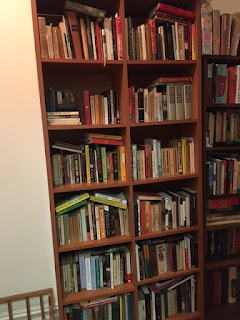
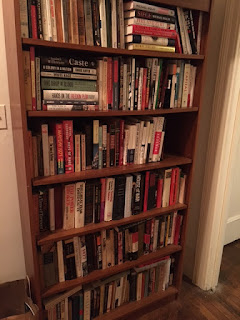
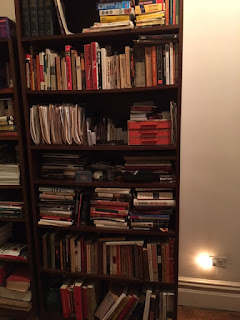
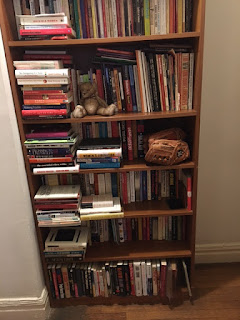
The New York Times Real Estate section this weekend has an article about people who still have physical print books and keep them in their own private libraries. I don’t have a library per se, but I do have a lot of books, which I have to cull periodically because I don’t have infinitely expandable space in my apartment. Four bookcases line a long hallway, and three and a half are in small hallway and a couple of rooms. They are roughly divided by category.


This one is all the fiction, alphabetically by author.


This one is American history, arranged chronologically from the bottom up. Some years ago I got rid of all the books about Vietnam and Watergate, to provide space for more recent history.


Here is world history, mostly European, but some Asian and African.


And here are all my women’s studies books, plus a bottom shelf of books by people I know. (Yes, that is a baseball glove on the fourth shelf up.)


No fancy shelving or sliding library ladder. But I can reach whatever I want when I want it.

Tuesday, September 21, 2021

Essay week 38: Football


Jane Coaston hosts the podcast “The Argument,” and recently she was discussing football, as in, is it ethical to be a football fan? She had two guests, one a sportswriter who covers the NFL, the other a former pro football fan who’s written “Against Football.” They all became football fans as children, watching games with their fathers (it was always the father). But as grownups, they began to wonder why they liked this game, which can be brutal and violent, and takes a huge toll on the bodies of the players.

            All of which got me thinking about when I was a football fan.

            No one in my family was a sports fan of any sort. So I didn’t grow up watching games with my father or my brother. I went to high school in Pennsylvania, however, and I think Pennsylvania rivals Texas in its devotion to football, especially high school football. As it happened, my high school had a powerful football team. Neshaminy High School was Lower Bucks County champion for most of the 1950s. In 1958, we even played the state champion, Allentown, and beat them, 18-0! I was on one of the buses that traveled from Langhorne to Allentown for the Friday night game, nervous after the hour ride to the strange city, and ecstatic on the ride home.

            Football at Neshaminy attracted everyone. There was no split between the college prep kids and the business or general track kids. Many of the college prep boys were on the team, and others were in the band that played at games. And everyone went to the games. We all bought an activity pass so we could take the school buses to home or away games. And some games were even broadcast on a local radio station; for some reason I couldn’t go to the game on Thanksgiving weekend, but while shopping with my mother that Saturday afternoon, I listened to part of the game on the car radio.

            Rooting for Neshaminy’s football team taught me the truth of Yogi Berra’s saying: “It ain’t over ’til it’s over.” In one game, we were behind by 10 points, with maybe three minutes left. I decided I might as well get a seat on the bus. I was past the bleachers and behind the scoreboard when a roar came from the crowd. Something was happened. I ran back in time to watch the miraculous plays that gave us a victory. I never left a game before the end again.

            Then we moved after my junior year. Still in Pennsylvania, but at a new school, new not just to me, it was only two years old, and its football team was pathetic. Harriton High School’s first year, 1958, its team won one game, lost 5, and tied one. The fall of 1959, my senior year, was worse, Harriton losing all nine of its games. I lost all interest, not only because the team never won, but I knew none of the players, though a couple were in some of my classes. Worst of all, the football coach, Mr. Wilcox, was my Social Problems teacher — and he seemed one of the stupidest adults I’d ever known. One of our weekly assignments was to read Norman Vincent Peale’s newspaper column in the Sunday Philadelphia Inquirer to discuss on Mondays. (Peale was the author of “The Power of Positive Thinking,” and positive thinking wasn’t helping Harriton’s football team.) Mr. Wilcox also believed in abstaining from alcohol. When someone in class mentioned that wine is in the Bible, Mr. Wilcox assured us that the Bible used “wine” to refer to “grape juice” — it was the same thing.

            I went to a college with no intercollegiate sports, and no football of any sort. I had no more interest in that sport.

            Then came 1968 and the 1969 Super Bowl. We had just bought a TV, which my husband had decided he needed as a new reporter at the New York Post; he was often assigned to interview the latest TV sit-com or drama star, and without a TV, he had no idea who these people were. In the runup to the third Super Bowl, there were plenty of interviews with the New York Jets quarterback, Joe Namath, and he was gorgeous. The Jets were also distinct underdogs, and having been a Philadelphia Phillies fan in the 1950s, I had learned the moral courage of rooting for the underdog.

            One day Jack came home from the Post to announce that the pressmen at the paper were taking bets on the Super Bowl, and was I interested? Why not? Put $5 on the Jets, I said, and we watched the game, exhilarated as Namath and the Jets overcame the heavily favored Baltimore Colts. That clicked my football attraction back into place, and for the next several years, we followed the Jets closely, even as they slipped down in the standings. Along the way we finally bought a color TV with what then counted as a big screen, 19 inches.

            Then came 1986. The New York Mets won the World Series, and I was fully back in baseball territory (that's a whole other story), reading the sports pages in the off-season for the first time. For a few more years, I watched baseball games between February and November, and football between September and February. That overlap in the fall was a bit difficult to navigate. Did I really want to keep doing this?

            One day I was watching pro football, probably a playoff game. It had snowed earlier, but warmed up enough to leave the field frosty and muddy at the same time. Players were slipping and sliding, getting hit and falling into mud. I was enjoying this — and caught myself. Was this why I liked football, to watch grown men who must feel cold and miserable running and banging into each other? Was this game bringing out the sadist in me? It was time for me to stop. 

          (The stories about concussions and brain injury came out later, and sealed my decision.)

Wednesday, September 15, 2021

September Golden Shovel #15

I’ve never been old before. This new old body could be floating

Through ether in another universe, but it is not so far away.

Does it tether me or loosen ties? Does it rely on

Gravity or defy it? What is the name of an internal pinch, an

Ache in my back, my leg, my foot? Does rain age as it flows from island

Sea to cloud to stream? I test each body part in a ferment of

Anxiety, try to return to the time when all I would do is dance.


source: Floating Away on an Island of Dance

September Golden Shovel #14

My aging body is new to me. How like prisons

Are the body templates women must match, built

On fantasies of a male hive mind, cultivated by

Women who slip under the door, themselves matched to the

Template and spending money for makeup, clothes, procedures, needs

Not self-created. What template forces my aging body, that

Material container, to fit an imaginary dream? Whose rule

Says sagging, wrinkles, unsteadiness, randomness is not us.


source: Prisons Built by the Needs That Rule Us

Monday, September 13, 2021

September Golden Shovel #4

I read about rural women in Afghanistan, how

They feared the Taliban, relied on the Taliban, feared the

Taliban again. They did not understand the myth

Of urban women wanting education. Women of

The countryside wanted food, peace. What did digital

Pictures mean to them? Did they have cellphones on a platform

Of mountains blocking signals, but not bombs, drones. Magic

Could explain the craziness of liberators hiring enemies. It goes

Without saying that normal life, in these times, goes poof.


source: How the Myth of Digital Platform Magic Goes Poof

Sunday, August 22, 2021

August Golden Shovel #20

The writer stares at a blank white window, a

Reminder that she must write 1,000 words today. She’s a novelist

With five books, each one starting as empty screen. Who

Knows if this one will finally coalesce. She turns

To another window, sees gray clouds bunch on the

Horizon. The air vibrates, anticipating a feast from tables

Of nimbostratus. Raindrops spell words on

The glass, jolting her fingers to keyboard and a new history.


source: A Novelist Who Turns the Tables on History

Wednesday, August 18, 2021

July Golden Shovel #18

Science speaks, but who listens? Crossroads are where

Two sides meet, to yell, perchance to talk. Few

Are comfortable with the uncertainty of a new disease that got

From somewhere to here. We waited anxiously for a vaccine,

But when it came, only half took it. There were many

Who thought the vaccine was a Trojan horse. They have

Refused vaccines until they got sick, then wish they’d gotten

It. They beg for it in the ICU, but now they are too sick.


source: Where Few Got Vaccine, Many Have Gotten Sick

Tuesday, August 17, 2021

August Golden Shovel #15

She lunges for the iron door, hoping to escape, but she’s

Just too late. She’s drowning in sparkles of dust that rise in a

Tidal wave. Destiny rings a torrent, echoing the shape-shifting

Stars, who beckon a tease. She reverses the artist,

Sloughs off history, whips coins into a froth. Who

Will drink the potion of morning, glory in the plays

That star her lovers? She’s locked in an iron box where all

Her fears braid chains in crimson, cobalt, waiting for the

Moment that ties her in knots, yet unravels all her parts.


source: She’s a Shape-shifting Artist Who Plays All the Parts

August Golden Shovel #2

She feels her arms too long, her legs too short

To reach the stars, her desired goal for answers on

The questions that wake her at midnight. How many doses

Of moonlight will awaken her dead mother and

How many sprigs of belladonna will feed the dreams struggling

To strangle her? Will Orion hunt down her demons to

Feed his hounds? Is it Virgo or Hydra who will deliver

Her from Nature’s womb? She submits to the universe, to them.


source: Short on Doses and Struggling to Deliver Them


July Golden Shovel #19

Her arms and legs are the wrong size to fit the rules

For swimming in Hades’ lake. She’s told to trim for

Form, but where to begin. Everyone is watching, audiences

Of one or a thousand, hoping she glues herself shut. She can

Blur hopes, but whose desires strangle the night, spin

Her needs to suit the ruling class way over our heads.


source: Rules for Audiences Can Spin Heads

July Golden Shovel #14

Her spirit rallies while she sleeps under trees, with

No limits. Reality jimmies the lock to her dreams, 

Glaze of light bursts borders, crashes onshore, making sport

Of wishes that juggle for attention, nowhere near

Satisfaction. She’s reprieved for a moment, huddles in a

Corner, gathering allies and strategy and tactics, critical

To overcoming reality. No gods rescue her at the crossroads

Of hope and despair, yet she holds close a nostalgia

For the time before birth, when all possibility reigns.


source: With the Sport Near a Critical Crossroads, Nostalgia Reigns

July Golden Shovel #11

Her hold on power is stronger than gravity. She’s not sorry

She rules. It is her right. We bow before her, we

Bring tribute: sunflowers, mica chips, hummingbirds that aren’t

Quite adult. We crawl before her, caress her feet, going

Back to our cabins refreshed. We return at dawn, back

To groveling, but now she’s impatient, daring to

Demand equality. We do not understand her words. Their

Sound rocks our innards, twisting us into images of movies.


source: Sorry, We Aren’t Going Back to the Movies

Tuesday, August 3, 2021

SOLTuesday: Masks

I ran into an old friend on the street today. He’s about my age, 70s, more my husband’s friend than mine. I was masked, he was not, so I recognized him before he recognized me. 

            I commented that it was easier to recognize people by their eyes than I had expected. He commented that I was wearing a mask. 

            Well, I said, I’m wearing a mask on the street where there are lots of people. He said, we’re outside, you don’t need a mask. 

            I said, how does it hurt you if I’m wearing a mask? I’m not judging you for not wearing one. (I felt he was judging me for wearing one.) 

            He said, there’s a little space around your nose where the mask doesn’t fit tightly. I pressed the mask closer to my nose. 

            I feel safer with the mask. He feels safe without it. We agreed to disagree.

-------------------------------------

It’s Slice of Life Tuesday over at Two Writing Teachers. Check out this encouraging and enthusiastic writing community and their slices of life every Tuesday. And add one of your own.